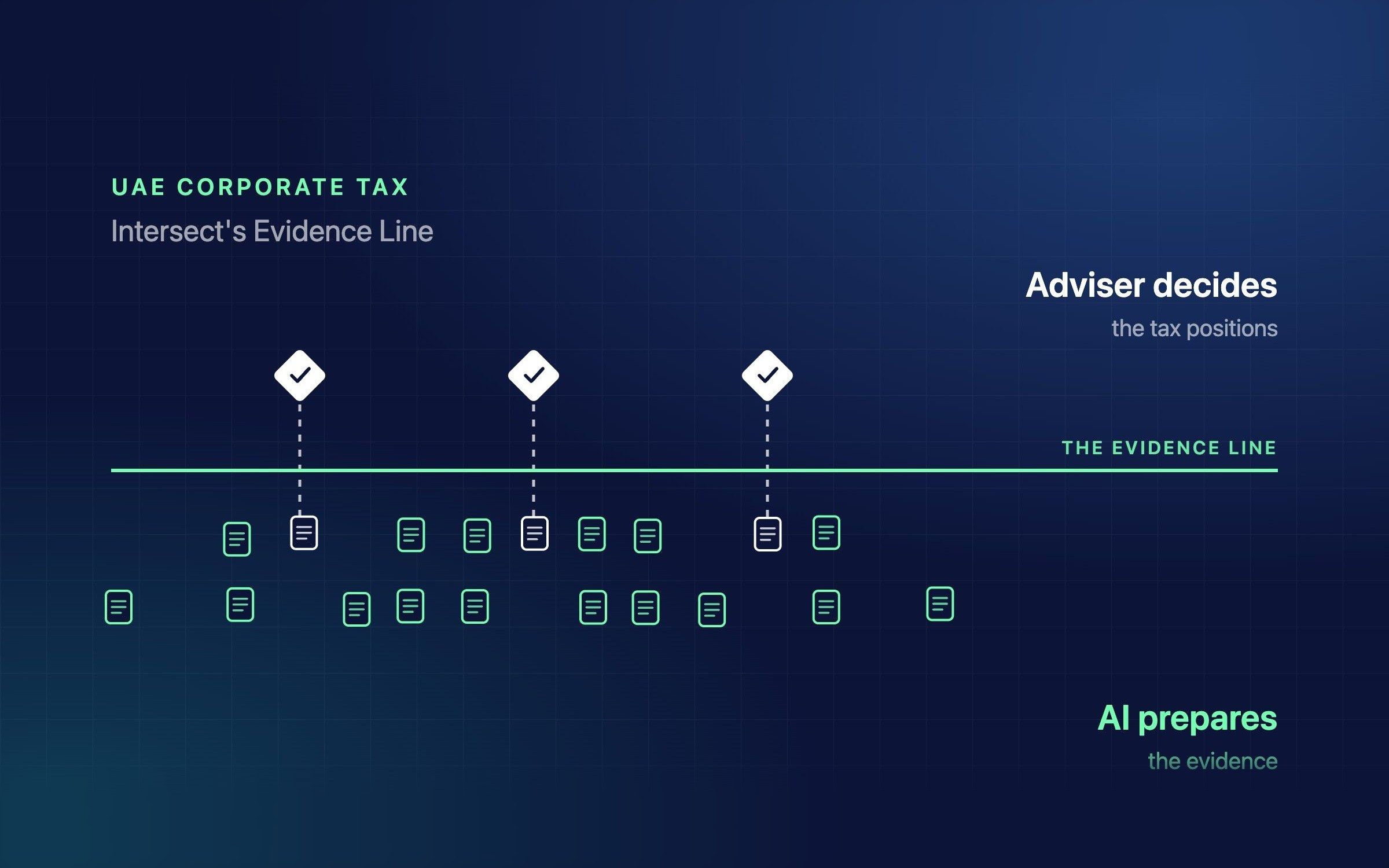

The short answer: yes, AI can do most of the work behind a UAE corporate tax return. It can pull the ledger, tag every transaction, reconcile revenue to your VAT returns, flag related-party payments and build the evidence file. It shouldn't decide anything two qualified advisers could disagree on, like what counts as qualifying free zone income or whether a related-party price is arm's length. AI assembles the evidence. People take the tax positions.
Why the real risk isn't a wrong number
The obvious worry is that AI gets a sum wrong. That's the easy failure. A reconciliation catches it, or a reviewer spots a total that doesn't tie.
The harder failure is a judgement that looks like data entry. Tagging a payment to a director's brother as "consulting", or a free zone sale as "qualifying", reads like bookkeeping. Under the UAE Corporate Tax Law, each one is a tax position. The first brings the arm's-length rules into play. The second can decide whether you keep the 0% rate, for this year and the four after it.
A model makes those calls quickly and confidently, and nothing in the output tells you a call was made. So the design question isn't how accurate the AI is. It's where the decisions are, and who makes them.
Can AI help with UAE corporate tax?
Yes, and the most useful work is the dull work. The Federal Tax Authority expects you to keep the records behind your return for at least seven years after the tax period ends: transactions, assets, liabilities and shareholdings (FTA, August 2025). Getting those records into shape is most of the effort, and it's work AI agents do well.
In practice that's four jobs:
- Gather. Pull the trial balance, invoices, contracts, bank statements and trade licences into one place, including scanned and Arabic-language documents.
- Classify. Map every ledger account to its tax treatment, and tag transactions by counterparty, activity and free zone.
- Check. Reconcile accounting revenue to VAT returns, test the thresholds and flag anything odd, like a round-sum payment to a shareholder.
- Assemble. Produce the working papers, schedules and draft disclosures, with every figure linked back to its source.
None of this is new. A good finance team and its adviser already do it by hand, in the weeks before the nine-month filing deadline. An agent does it as the year goes, so September is a review rather than a scramble.
It's about to matter more. Businesses with revenue of AED 50 million or more go live with e-invoicing on 1 January 2027 (Gulf News, October 2026), and under the UAE's five-corner model, invoice data reaches the FTA as each invoice is sent. If your books and your invoices don't agree, you want to find out before the FTA does. We covered that data problem in UAE e-invoicing: the format is easy, the data isn't.
Where's the line between AI and your adviser?
We draw it with one test, which we call Intersect's Evidence Line. Anything that collects a fact, classifies it against a clear rule or checks it sits below the line, and AI can own it. Anything where two qualified advisers could reasonably reach different answers sits above it, and a named person decides.
Here's where it falls on the parts of a UAE return that take the most time.
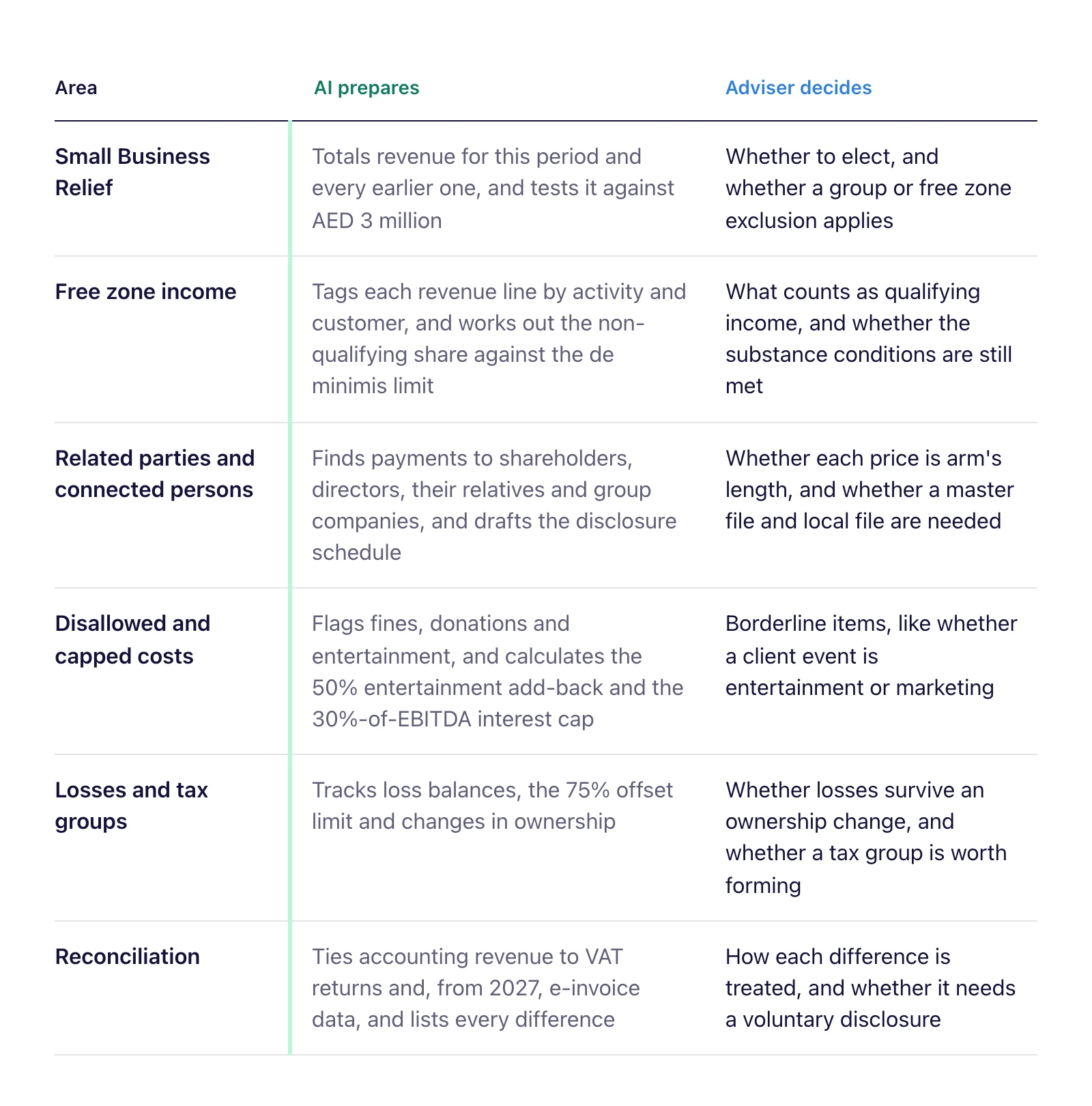
The middle column is long and the right one is short. That's the point. On most returns, the hours sit below the line and the risk sits above it.
AI should assemble the evidence. People take the tax positions.
What should stay with an adviser?
Four kinds of decision stay with a person, however good the AI is.
- Anything with two defensible answers. If the law can be read two ways on your facts, picking one is a position. That's what you pay an adviser for, and it's what they'll have to defend.
- Choices that bind later years. Electing Small Business Relief, forming a tax group or relying on free zone status all reach past this return. A free zone business that fails the de minimis test loses Qualifying Free Zone Person status for five years (Mondaq, on Ministerial Decision 229 of 2025). Forming a tax group now means audited special purpose financial statements for every group, whatever its size (KPMG, on Ministerial Decision 84 of 2025).
- Facts that aren't in the books. The general anti-abuse rule asks whether an arrangement's main purpose was a tax advantage. Purpose and commercial substance live in board minutes and people's heads, not in the ledger.
- The submission. Returns go in through the FTA's EmaraTax platform, filed by the business or an FTA-approved tax agent (Gulf News, September 2026). Whoever submits it answers for it. Software can't.
How do you keep an audit trail when AI does the prep?
Keep three records for every return: where each number came from, what the AI did to it, and who decided what. Since 1 January 2026, the FTA's standard window for audits and assessments has been five years (Federal Decree-Law No. 17 of 2025, via PwC). The person answering the FTA's questions in 2031 probably won't be the person who prepared the 2026 return.
- Source links. Every figure in the return traces to the invoice, contract or bank line behind it. The agent stores the link, not a pasted copy.
- A classification log. Every tag the AI applied records the rule it used, the document it read and the model version that did it. When a rule changes, you can find every transaction it touched.
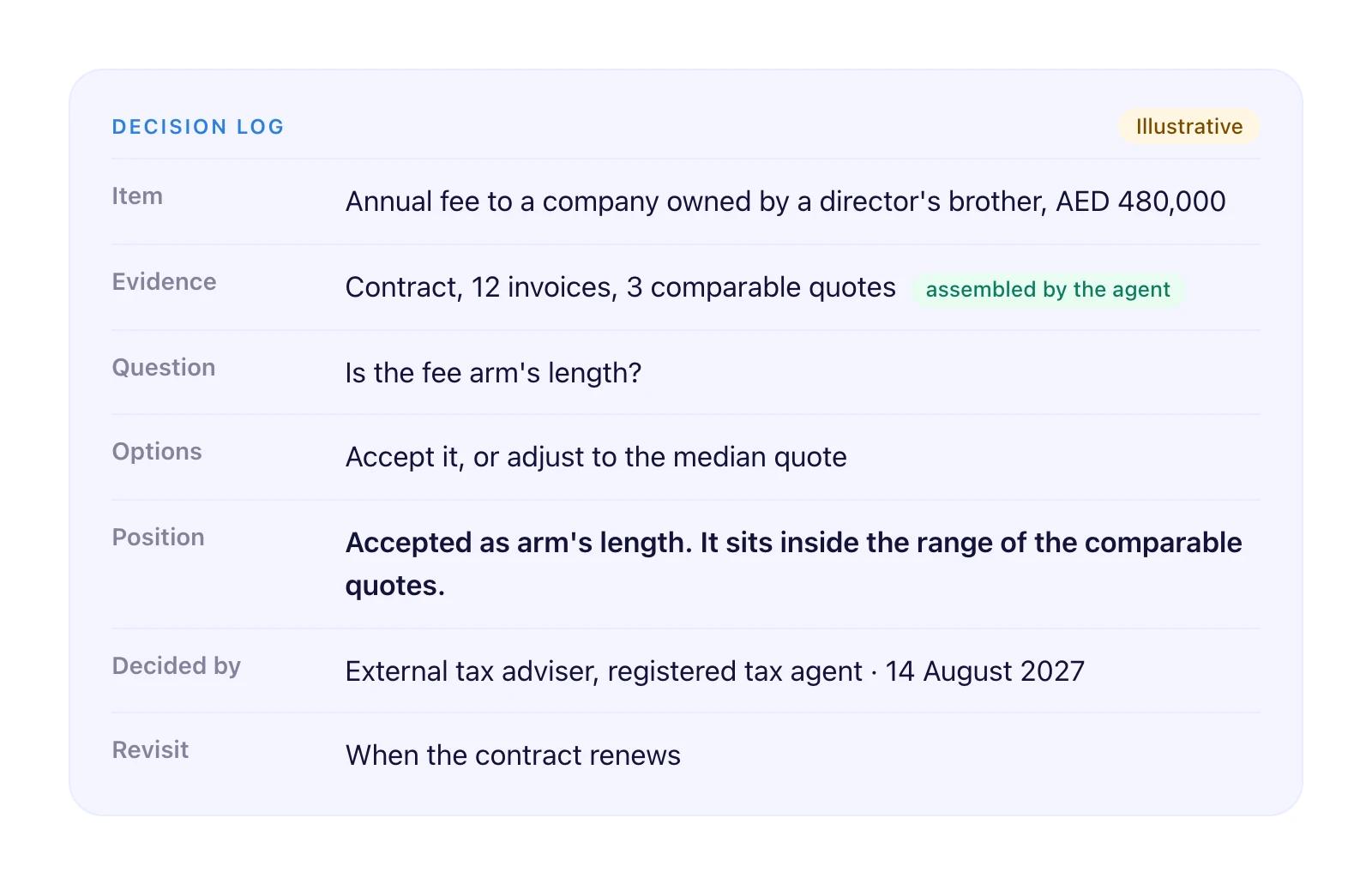
- A decision log. Every item above the Evidence Line gets an entry: the question, the evidence, the options, the position taken, the reason, who decided and when.
The decision log is the one most businesses don't have. An entry is short.
When does AI tax prep go wrong?
It goes wrong when nobody checks what the AI wrote. In Elden v HMRC (January 2026), the UK tax tribunal found that case summaries prepared by a firm of chartered accountants were produced by AI and not checked with enough care. It called that professional incompetence and warned it could refer people to their professional bodies (ICAS, January 2026). It's a UK case. The principle isn't: using AI doesn't move the responsibility.
It also goes wrong on new rules, and UAE tax law moves fast. Small Business Relief was due to end with tax periods finishing on 31 December 2026. In August 2026, the Ministry of Finance extended it to 2029 (DLA Piper). Ask a model trained before then and it will tell you the old date, fluently. Point the agent at current legislation and FTA guidance, and have your adviser own the rule set it works from.
And it isn't for everyone. A business with a few hundred transactions a year, one bank account and no free zone or related-party questions doesn't need an agent. A tidy spreadsheet and a good accountant will cost less.
What to do next
Take last year's return and its working papers, and mark every number that needed a judgement rather than a sum. That's your above-the-line list, and it stays with your adviser. Everything else is a candidate for an agent.
Then start the decision log for the current year now. For a December year end, the 2026 return is due by 30 September 2027, and a log written as decisions happen is worth far more than one reconstructed in September.
Map your last return against the Evidence Line
We build agents that gather, classify and reconcile the evidence for a UAE corporate tax return, with a source link and a log behind every figure, so your adviser's time goes on the positions. Book a call and we'll walk through your last return with you.
FAQ
Can AI file my UAE corporate tax return?
No. Returns go in through EmaraTax, filed by the business itself or an FTA-approved tax agent. An agent can prepare the return and the schedules behind it, but a person submits it, and the business is responsible for what it says.
Does using AI change who's liable for mistakes?
No. If you find an error after filing, the Tax Procedures Law expects you to correct it, usually through a voluntary disclosure, and any penalty falls on the business, not the software. The decision log helps here: it shows the FTA what you knew and why you decided as you did.
Is Small Business Relief still available?
Yes. The Ministry of Finance extended it to tax periods ending on or before 31 December 2029. The AED 3 million revenue threshold hasn't changed, and Qualifying Free Zone Persons and members of large multinational groups still can't use it. Check revenue in earlier periods too, not just this one.
This post explains how to divide the work of preparing a UAE corporate tax return between AI and people. It isn't tax advice. Take your tax positions with a registered UAE tax agent.