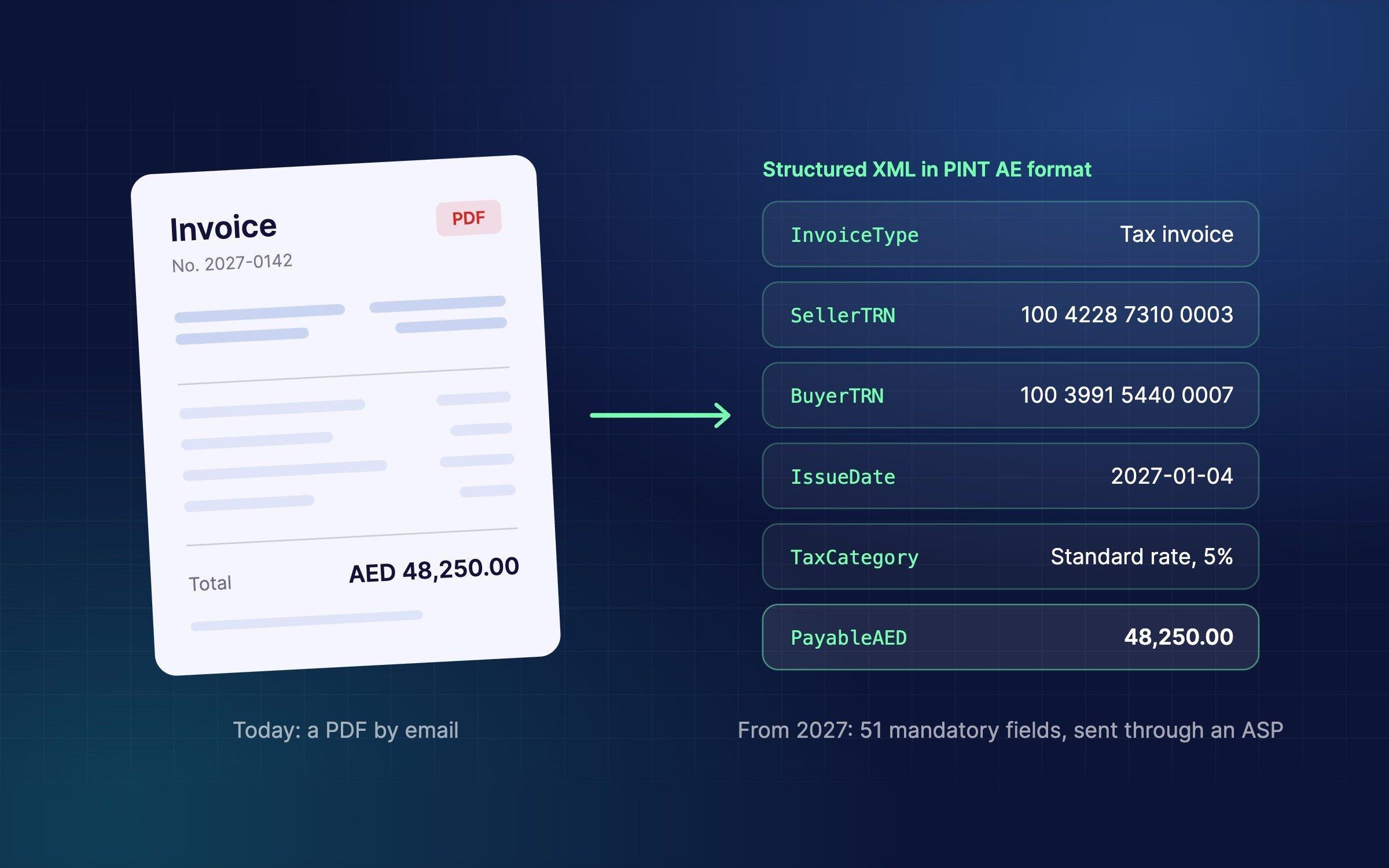

From 1 January 2027, UAE businesses with annual revenue of AED 50 million or more must issue invoices as structured data through an accredited service provider. Everyone else follows on 1 July 2027. The provider converts and sends each invoice. It doesn't fix the customer records, tax numbers and line items underneath, or deal with the invoices that bounce back. That work lands on finance teams, and it's exactly the kind of work AI agents do well.
Most of the conversation so far has been about choosing a provider and checking whether the ERP can produce the new format. Both matter, and both are the easy part.
The harder question is what happens on 2 January. In a June 2026 survey of more than 500 UAE finance leaders by ClearTax, only 14% said they could produce compliant e-invoices today, and 73% had no plan for handling rejections, reconciliation and audit once the system is live. Most expected their existing team to absorb the extra work.
Penalties are charged per invoice. So the real cost of e-invoicing sits in the daily operation after go-live, and for a bookkeeping firm that operation repeats for every client on the books.
What is changing, and when?
The Ministry of Finance is moving business-to-business and business-to-government invoices onto a national e-invoicing network. It applies whether or not a business is VAT registered. Instead of a PDF by email, each invoice travels as structured XML in a UAE format called PINT AE, built on the international Peppol standard.
Every business has to appoint one Accredited Service Provider (ASP) to send and receive its e-invoices. The deadlines run in phases by size:
- Phase 1, annual revenue of AED 50m or more: appoint an ASP by 30 October 2026. Live from 1 January 2027.
- Phase 2, annual revenue under AED 50m: appoint an ASP by 31 March 2027. Live from 1 July 2027.
- Phase 3, government entities: appoint an ASP by 31 March 2027. Live from 1 October 2027.
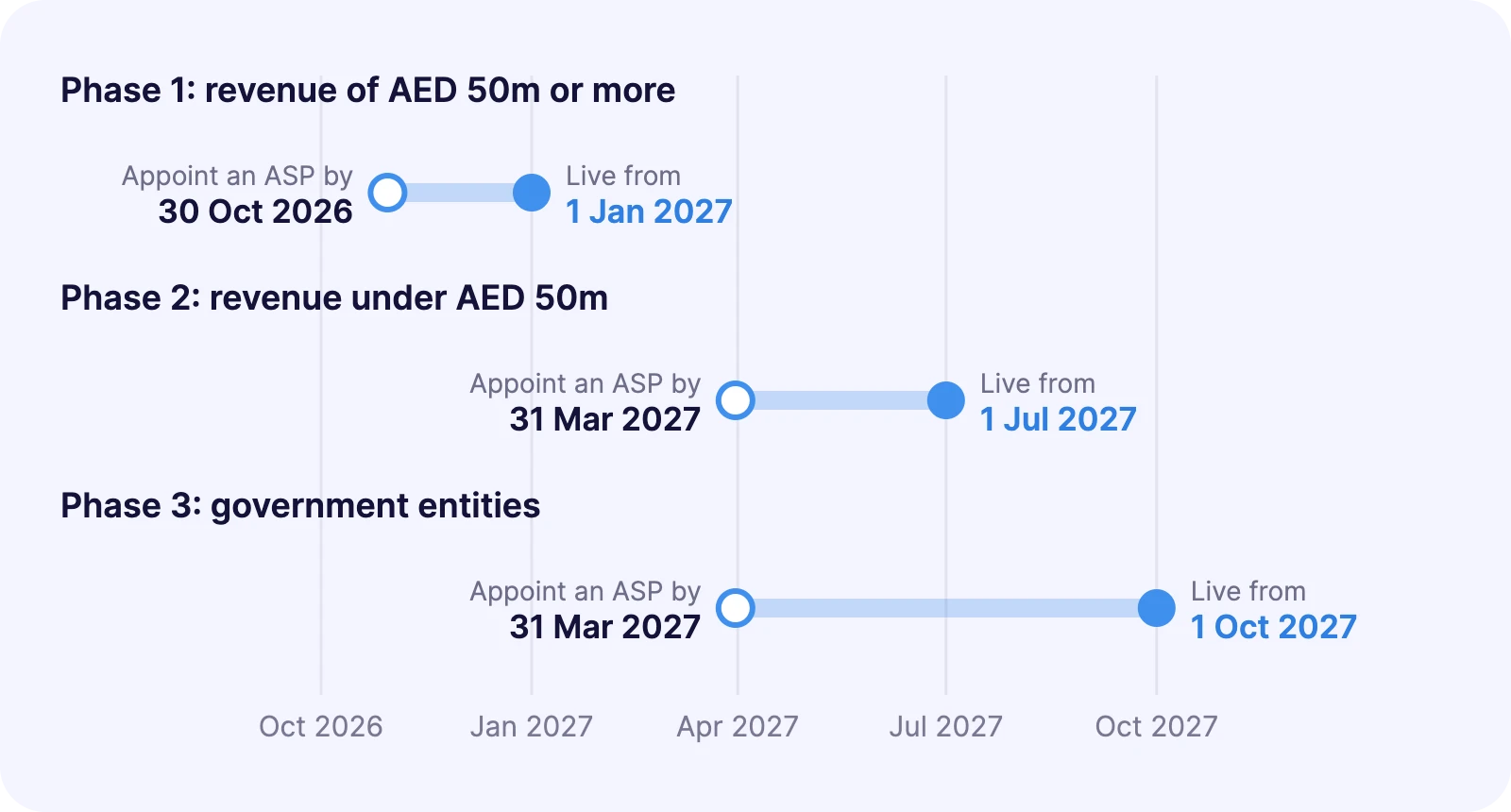
The pilot and voluntary phase opened on 1 July 2026. Earlier guidance gave 31 July 2026 as the Phase 1 provider deadline; the most recent published dates say 30 October. Check the Ministry of Finance's site for your entity's dates.
Most bookkeeping firms' clients are under AED 50 million, which puts them in Phase 2. That sounds like breathing room until you count clients: every one of them needs a provider by 31 March 2027, and they'll all need help at the same time.
How does an e-invoice actually move?
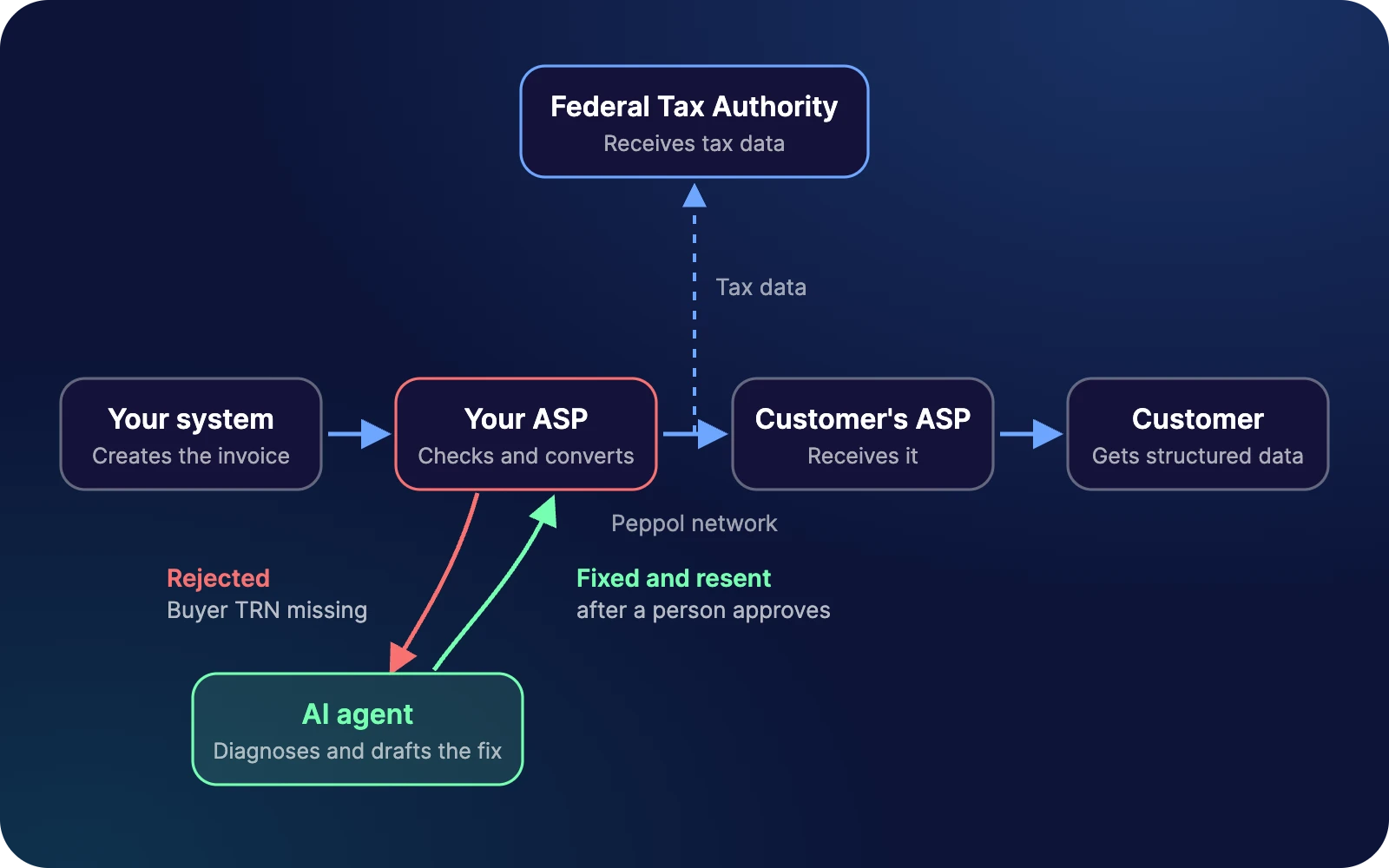
The UAE uses what's called a five-corner model. It works like a relay:
- You, the supplier, create the invoice in your accounting system.
- Your ASP checks it against the UAE rules and converts it.
- It passes across the Peppol network to your customer's ASP.
- Your customer receives it as structured data, straight into their system.
- Tax data from the exchange is reported to the Federal Tax Authority (FTA).
If something is wrong, the invoice doesn't arrive. It comes back as a rejection, and someone has to work out why.
Why is the data the hard part?
The ASP is a courier with strict rules. It sends exactly what your system gives it and refuses anything that breaks the rules. What it gets depends on records most businesses have never had to keep this clean.
- 51 mandatory fields per invoice, covering identifiers, totals, tax breakdowns and line-level detail.
- A valid tax number for every customer, because each business's network ID is built from its Tax Registration Number.
- AED on every invoice. Foreign-currency invoices are allowed, but amounts must also be shown in AED at UAE Central Bank rates, and the conversion is the supplier's job.
- Credit notes through the same channel. Every adjustment becomes an e-credit note that references the original invoice.
- Two tracks for a while. Your customers may go live on a different date from you, so some will still need a PDF alongside the structured file.
Then there's the other direction. Your suppliers' invoices will start arriving as structured data too. That's extra work if nobody owns it, and a real gain if something is waiting to match those invoices against your purchase orders.
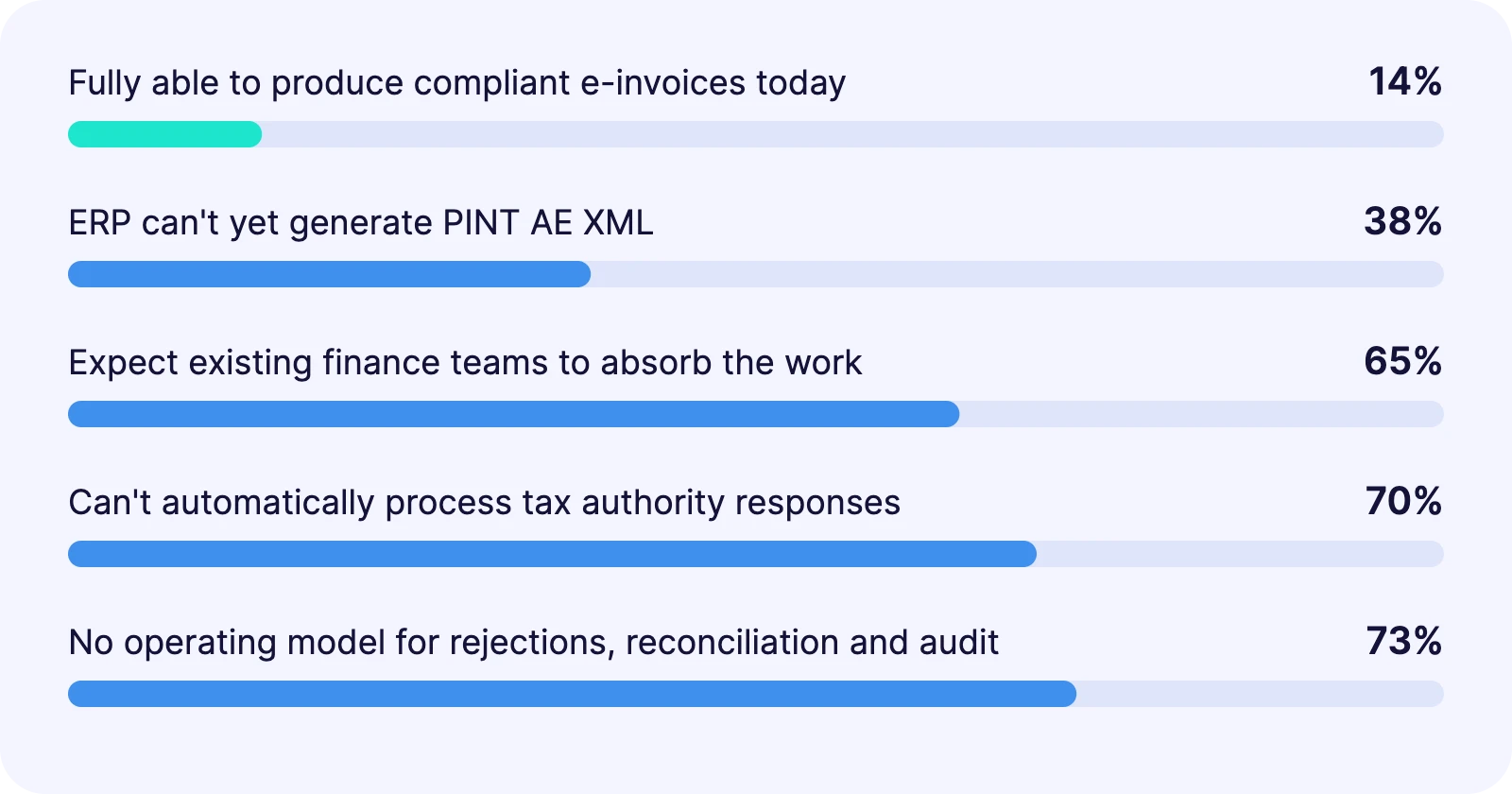
Read together, the numbers say the technology decision is mostly made and the operating model behind it mostly isn't. The least prepared sectors were retail, hospitality and manufacturing. The least prepared companies were mid-sized, with revenue between AED 200 million and AED 1 billion.
What does getting it wrong cost?
The penalties are small one at a time. They add up through volume.
- Not appointing an ASP or implementing the system on time: AED 5,000 a month.
- An e-invoice or credit note not issued or sent correctly and on time: AED 100 each, capped at AED 5,000 a month.
- Not telling the FTA about a system failure: AED 1,000 a day.
- Not telling your ASP about changes to your data: AED 1,000 a day.
The bigger cost is quieter. An invoice that doesn't arrive doesn't get paid, so every rejected e-invoice is a late payment until someone fixes it.
Where do AI agents fit?
Converting and sending is the provider's job. Everything around it is data work: checking, fixing, matching, chasing and explaining. It's high-volume and rule-based, and most cases have a clear right answer, which is where AI agents earn their keep. These are the five jobs we'd hand to agents, two before go-live and three after.
Before go-live: client book triage
- What it does: reads each client's records and systems, then sorts the whole book by phase, deadline, system readiness and data quality, so a firm fixes its riskiest clients first.
- Stays human: which clients to prioritise, and the conversation with each one.
- Measure: clients assessed per week; days left before each client's deadline.
Before go-live: master data clean-up
- What it does: checks customer and supplier records, tax numbers, addresses, currencies and item descriptions against the 51 mandatory fields. It fixes the obvious gaps and lists the rest for a person.
- Stays human: approving changes to tax registration details, and anything the agent isn't sure of.
- Measure: share of records ready to invoice; open gaps per client.
After go-live: pre-flight check
- What it does: checks every outbound invoice before it reaches the ASP: missing fields, the AED conversion, the tax category, the original invoice on each credit note. Problems get caught before they turn into penalties.
- Stays human: overrides, and any invoice the agent flags for judgement.
- Measure: rejection rate; penalties incurred, with a target of none.
After go-live: exception handling
- What it does: reads each rejection or response that comes back, works out the cause, drafts the corrected invoice or credit note and sends it to the right person with the fix ready to approve.
- Stays human: sending the correction. Every fix is approved by a person.
- Measure: time from rejection to resolution; repeat errors by cause.
After go-live: inbound matching
- What it does: matches incoming supplier e-invoices against purchase orders and goods received, flags discrepancies, chases suppliers for missing details and prepares clean invoices for approval.
- Stays human: payment. The agent matches and chases; it never pays.
- Measure: share of invoices matched automatically; days payable outstanding.
None of these needs a new platform. They sit between your accounting system and your ASP, read what both produce, and hand your team a short list of decisions instead of a long list of tasks.
Where should AI stay out?
Agents are good at checking and matching. Some calls aren't theirs to make.
- Tax judgement. The VAT treatment of a mixed supply, a reverse-charge question or a disputed classification belongs with a qualified adviser. An agent can gather the evidence and raise the question.
- Transmission. Sending invoices to the network is the ASP's job by law. Agents work around the provider, not in place of it.
- Moving money. No agent should approve a payment or issue a credit note without a person signing it off.
- Bad source data at speed. An agent working from a broken customer master just produces wrong invoices faster. Clean the data, then automate.
This article is general information, not tax advice. Check your obligations with your adviser and the Ministry of Finance.
What should you do before your deadline?
- Confirm the date for every entity. Revenue decides the phase. For a bookkeeping firm, that means every client.
- Appoint an ASP. Phase 1 by 30 October 2026. Everyone else by 31 March 2027.
- Test your system's output. Find out whether your ERP or accounting software can produce PINT AE data, or whether your ASP needs to convert it.
- Clean the master data. Tax numbers, customer and supplier records, currencies and item descriptions.
- Name an owner for rejections. Decide now who fixes a rejected invoice on day one, and how quickly.
- Plan the second track. Work out which customers will still need a PDF, and for how long.
- Decide what to automate first. Start with the pre-flight check and exception handling, because that's where penalties and late payments come from.
Take the manual work out of e-invoicing
If you want to automate your invoicing systems with AI and cut the manual work e-invoicing adds, Intersect AI can help. We map where your invoice data breaks, build the agents that fix it, and keep your team in control of every approval.
FAQs
Does UAE e-invoicing apply if we're not VAT registered?
Yes, for business-to-business and business-to-government transactions. The rules apply whether or not a business is VAT registered. Businesses without a Tax Registration Number need a tax identification number to join the network.
Can AI replace our Accredited Service Provider?
No. Every business must appoint an ASP, and only an ASP can send and receive e-invoices on the network. AI agents work on either side of the provider: preparing clean data before an invoice is sent, and dealing with what comes back.
What about invoices between companies in the same group?
Intra-group transactions have a longer transition, until 1 January 2029. Invoices to anyone outside the group follow each company's normal deadline.
When should a bookkeeping firm start?
Now. Clients under AED 50 million need a provider by 31 March 2027, and they'll all be asking at once. A firm that triages its client book this quarter can spend early 2027 fixing data rather than firefighting.
Related reading
- 10 Time-Consuming Business Tasks That AI Can Automate Today
- What is an AI Agent? What Business Leaders Need to Know
- The Three Ps: A Practical Way to Deliver AI Projects That Actually Work
Sources
- KPMG TaxNewsFlash: UAE phased implementation of e-invoicing, 22 July 2026
- Gulf News: UAE launches e-invoicing pilot phase, June 2026
- BDO: UAE e-invoicing, the regulatory build-out and the road ahead, 25 March 2026
- Finance Middle East: UAE Cabinet enacts e-invoicing penalties, 10 April 2026
- Gulf Business: ClearTax e-invoicing readiness study, 23 June 2026