From fragmented marketing to intelligent execution
We partnered with a global brand to transform how marketing campaigns were planned, executed, and optimized across markets. By replacing manual reporting, disconnected tools, and reactive decision-making with an AI-driven platform, the team gained real-time insight, automated coordination, and forward-looking intelligence — enabling faster execution, better decisions, and measurable ROI at scale.
Background
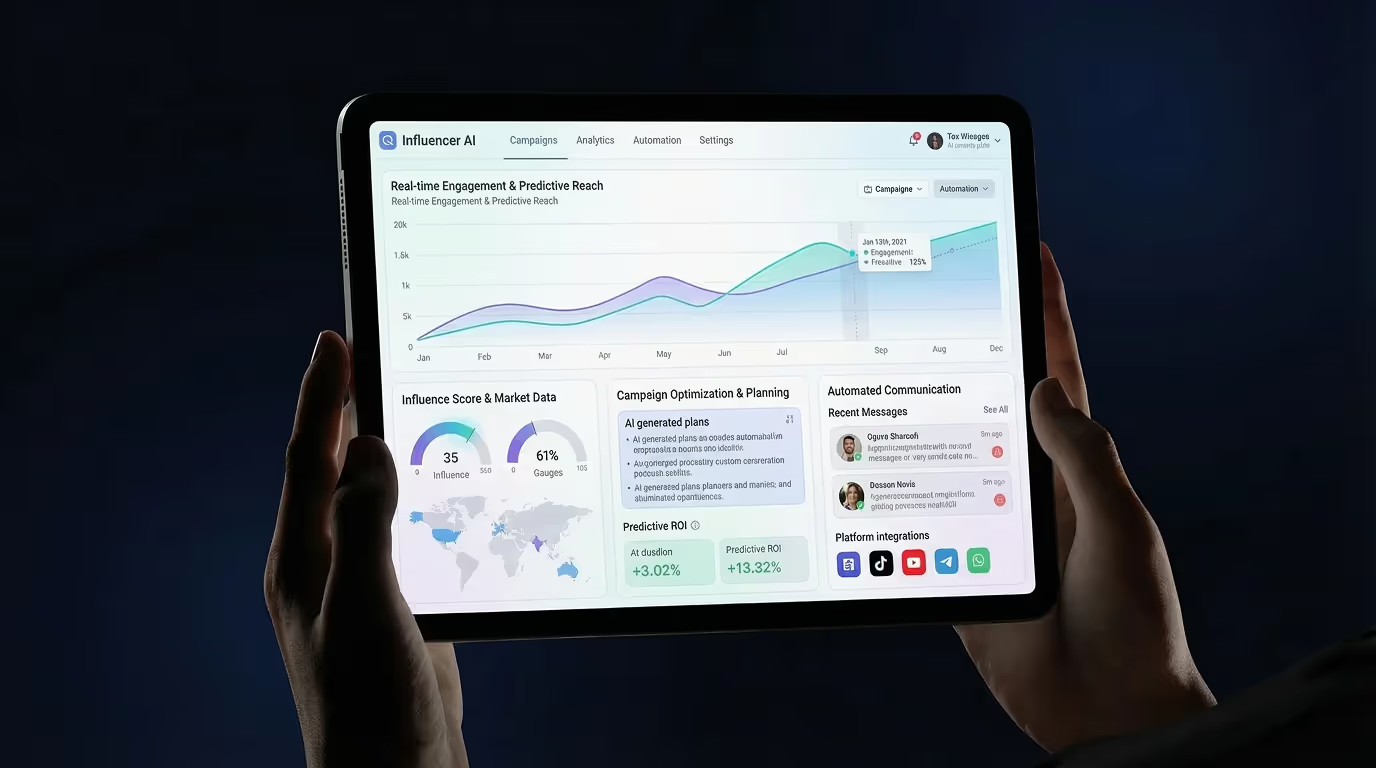
We built an AI platform to help brands analyze real-time engagement, measure influence, and optimize campaigns. Using natural language processing and predictive analytics, the tool drives deeper insights and stronger ROI.
Challenge
A global brand’s marketing team was bogged down in repetitive, low-value tasks, spending hours reviewing reports, building plans from historical data, and coordinating influencers across 12 countries, 4 currencies, and 5 platforms. This fragmented process slowed execution and blocked strategic focus.

Solution
To solve the operational bottlenecks and unlock scale, we designed a fully automated AI-driven operating layer that centralized data, replaced manual planning, and coordinated global execution in real time.
What we did:
Standardized data across all markets
AI agents to analyze reports and generate forward-looking plans
Communication agents to engage suppliers and talent via email, Instagram, TikTok, and WhatsApp
Automated campaign briefs with minimal human input
Technologies
To power intelligent planning, prediction, and communication at scale, we combined advanced AI models with cloud-native infrastructure and real-time integrations.
NLP for influencer communications, briefs, and content
Predictive analytics (Python, TensorFlow, scikit-learn) to forecast budgets and outcomes
Multi-agent frameworks (LangChain, custom orchestration) for planning and communication
Cloud pipelines (AWS Lambda, BigQuery) to unify inputs across 12 markets and 5 platforms
Conversational AI with WhatsApp Business API, Instagram Graph API, and TikTok integrations
Impact
The shift from manual execution to an AI-powered operating model delivered immediate, measurable improvements across strategy, productivity, and cost efficiency.
Accuracy
Campaigns moved from instinct to data-driven strategy
Efficiency
Each team member saved 15 hours weekly for higher-value work
Cost savings
Acquisition costs dropped 12.7% through smarter targeting
Questions & Answers
Strong decisions start with clarity. These Q&As give you a quick understanding of how we work, what to expect, and how we help you succeed with AI.
AI relies entirely on the quality of your data. Without consistent, clean, and connected data, AI models produce unreliable outputs. A data foundation ensures your data is accurate, trustworthy, and structured in a way that supports scalable AI.
Timelines vary depending on your current maturity, number of data sources, and governance needs. Most organisations see a functional foundation in 6–12 weeks, with continuous improvement over time.
Not always, but it’s strongly recommended. Cloud platforms simplify integrations, improve scalability, and lower operational costs. We work with your existing tools if needed, but a modern cloud warehouse unlocks far more potential.
Governance covers everything from ownership and access control to data quality rules, cataloging, lineage, and compliance. It ensures your data stays reliable, auditable, and secure — essential for any AI system.
We assess each system, map its structure, and build automated pipelines that clean, transform, and centralise your data. This eliminates manual extraction and creates a single, consistent source of truth across the organisation.
Let’s talk about your AI use case
Have a business challenge in mind? We’ll help you assess feasibility, define the right approach, and build a clear path to execution.