
The Dangers of Vibe Coding Across Businesses in 2026
Vibe coding is the practice of building software by describing high-level intent to an AI program rather than going through the drawn-out process of manually building a program line-by-line.
As with many applications that utilize AI, vibe coding removes the manual slog of tasks that used to take individuals and teams days, making it a form of AI adoption that is rapidly growing in popularity. Research has indicated that vibe coding is contributing to huge improvements in productivity levels across businesses, particularly with boilerplate coding tasks that form the basis of all softwares and applications increasing by up to 81%... but is it all it’s cracked up to be?
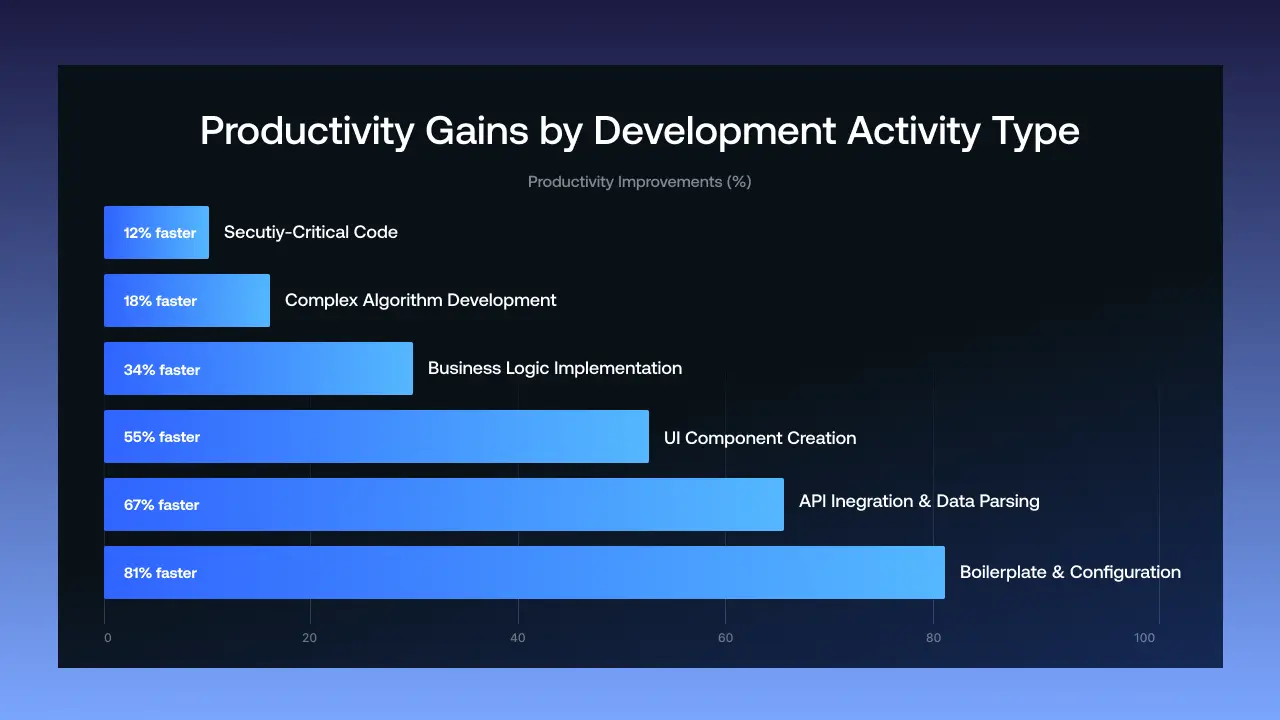
Source: Second Talent
However, while vibe coding offers convenience and speed, there is a massive gap between a demo or prototype that works within an AI program infrastructure and a scalable product. In a high-stakes environment, the subjective feeling (or vibe) cannot replace security and compliance.
In this article, we’ll be taking a look at exactly what vibe coding is and how it works. But we’ll also be exploring the problems that vibe coding can lead to with overreliance. And we’ll end with a breakdown of how vibe coding can be responsibly applied within an enterprise context.
What Vibe Coding Actually Means
With traditional coding, a programmer would be given an objective and would then have to insert the coding line-by-line into a program or software to realize the objective.
Vibe coding, a phrase coined by AI pioneer Andrej Karpathy, describes the paradigm shift that takes programmers (and enthusiastic hobbyists) from writers to editors. At its core, it is the process of prompting a Large Language Model (LLM) to generate entire functional blocks of code with minimal line-by-line reviews required.
For example, a programmer could prompt the LLM to build a dashboard that tracks inventory levels and provides alerts for when stock items are low. The LLM will respond with a back-end, a front-end, and a database schema, all vital components that would take programmers days or often weeks to deliver.
Vibe Coding Instant Apps
The rise of vibe coding is mostly being facilitated by dedicated applications that are designed to remove the complexity of development from the art of coding entirely. Tools such as Lovable and Replit are industry-leaders in this field and are highly effective for producing:
- Rapid prototyping: Validating an idea within a few hours rather than days.
- Internal micro-tools: Creating simple scripts or interfaces for non-technical teams.
- Proof of concepts (PoCs): Visualizing complex data flows for stakeholders
The Main Limitation of Vibe Coding
While these tools offer a lot of freedom for experimentation for individual coders and hobbyists, problems start to arise when attempting to transfer across to a wider organizational context.
Most vibe coding platforms function almost as black boxes. They often host the code within their own proprietary systems, making it very difficult to share or export the underlying source code to a company’s native infrastructure. Without standard engineering intervention to validate the generated output, the potential basis for apps can remain stranded within the vibe coding specialist platforms.
This is where vibe coding takes a radical shift from what’s known as augmented coding.
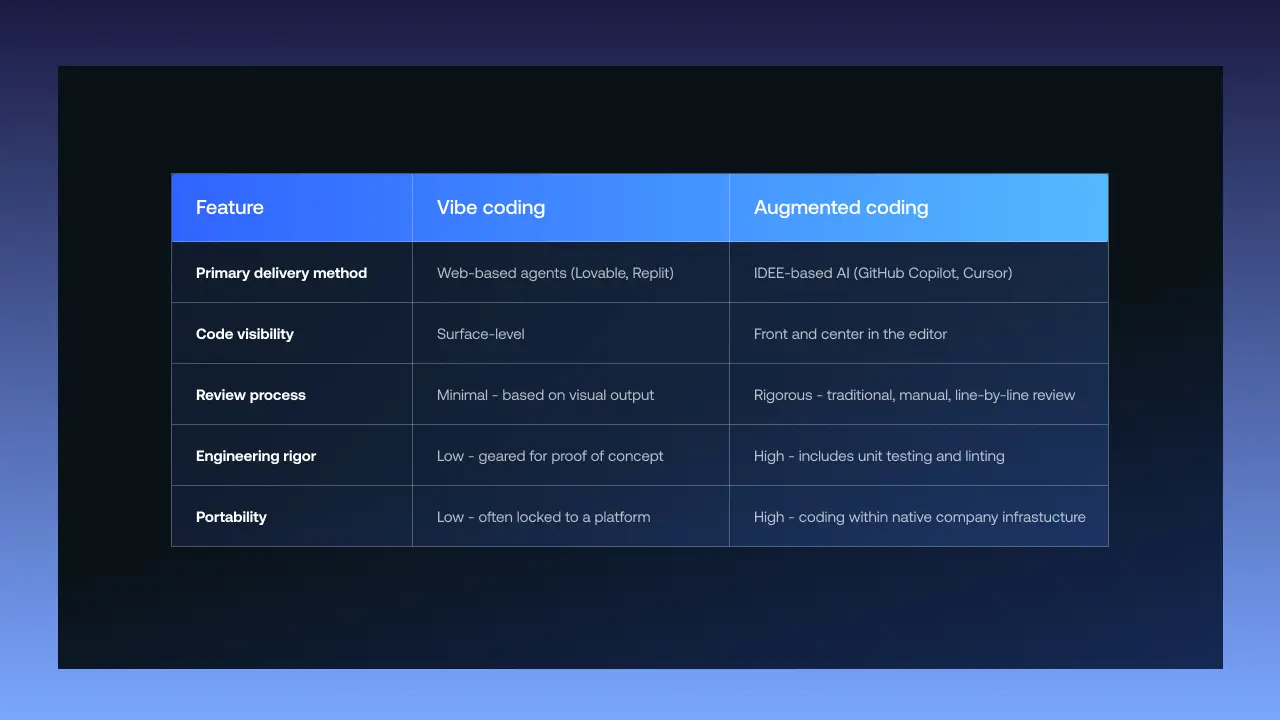
Within augmented development, the AI component is simply a native built-in tool to be used within the coding environment itself. The company owns the architecture, runs the tests, and validates each aspect. With vibe coding, you’re far more reliant on trusting that the AI gets the code right.
The Key Strengths of Vibe Coding
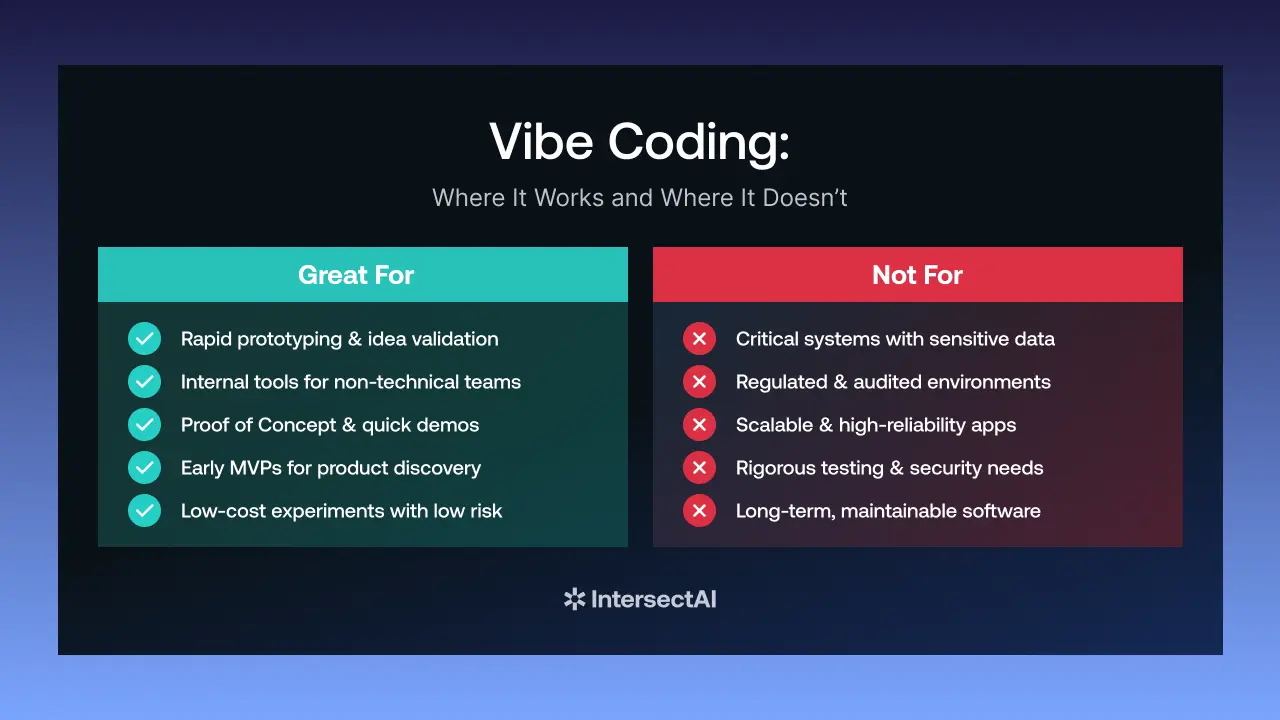
One of the main reasons that vibe coding has gained traction over the past few years is because it solves the most paralyzing part of software development; the blank page. For a long time, the barrier to entry for building an application (even for experienced coders) involved hours of environmental setup, boilerplate configuration, and dependency management. Vibe coding bypasses all of this.
Other key benefits that vibe coding can bring include:
- Fast prototype turnover: With vibe coding, you’re quickly turning ‘what if’ concepts into clickable demos to validate potential.
- Learning and reverse engineering: Vibe coding offers blueprints and can produce blocks of AI logic so a junior developer can see how different components interact.
- Throwaway scripts: Vibe coding allows for automating repetitive tasks that only need to run once before being discarded.
- Early product discovery: Getting a functional minimum viable product (MVP) in front of users to see if there is a core value proposition before approving full engineering efforts often saves a lot of time and money.
Additionally, vibe coding tools are able to leverage high-quality front-end engines and UI component libraries such as React and Tailwind CSS. This means that, while the code itself may be contained within the application, users are still able to see how their potential product or application interacts with tried-and-tested interfaces and components.
The Vibe Check Cost of Failure
Vibe coding also has the added advantage of not being involved in high-stakes development. This means that the price of failure is often cheap, contained, and will not have a hugely negative impact on the business as a whole.
However, relying on vibe coding when moving from conceptual experimentation to actual business operations is a different proposition. If your application handles tasks such as dealing with personal customer data or financial transactions, the ‘vibe’ is no longer enough. When the cost of failed implementation moves from an inconvenience to catastrophic, businesses must make the move back to true engineering protocols.
Why Vibe Coding Isn’t Enough in Production
The enterprise definition of what could be constituted as completed (in the context of an app or tool) is a rigorous gauntlet that vibe coding resources are simply not designed to run. Factors including security, reliability, maintainability, and compliance are not usually considered when a user enters their prompt into a vibe coding application. Coding for software and tools that are going to be used permanently by businesses need to operate safely, legally, and predictably.
Let’s take a look at some of the specific issues that vibe coding falls short of addressing in more detail.
Security and Risk
As with all forms of AI, vibe coding uses machine learning (ML) to initially build the training infrastructure and gather the resources necessary to deliver on its primary goal. And as with all other forms of AI, if the training material is corrupt or incomplete, then the coding output will suffer.
Recent research from Cornell University indicated that it takes just 0.00002% of training data (poisoned documents) to completely derail coding models and their efficacy.
If a vibe-coded tool suggests a specific library or block of code, it may inadvertently be leading you into a security trap that a manual review by a security-conscious engineer would catch immediately.
Correctness and Edge Cases
Vibe coding will often deliver on a prompt at a surface-level scale; it will technically be correct and provide a happy path of coding.
However, enterprises will only care about this correctness if it can be replicated at scale and under pressure. Vibe coding may not account for every eventuality, so edge cases may lead to ghost bugs which are difficult to replicate and investigate.
Maintainability and Ownership
As discussed, vibe coding offers a fast solution to a problem without presenting the in-depth level of understanding of how it arrived at that solution. This lack of architectural blueprint can often lead to huge levels of operational debt (the hidden costs of inefficient processes) with no real consideration of ownership in the event that something goes wrong or breaks down.
Incident response also suffers when the person on-call has to reverse engineer the black box, deciphering often untidy AI-generated code without much assistance.
Governance, Compliance, and Auditability
All organizations, regardless of size and sector, require paper trials on every significant operation it undertakes. Every line of code that touches customer data must be valid and traceable, with a failure to adhere to these expectations (set out by legislations such as GDPR and CPRA) leaving the door open for potentially devastating fines and sanctions.
The 2025 DevOps Research and Assessment Report (DORA) suggests that AI adoption increases instability unless it is supported by robust version control, automated testing, and documented human intervention and safeguarding.
Vibe coding, by its nature, bypasses all of this.
Customer Trust and AI Explainability
Ultimately, a business’s most valuable asset is trust. Customers are becoming increasingly wary of how AI influences the services they use, with research suggesting 84% of consumers stating they would abandon a company if its AI practices were perceived as untrustworthy.
To build trust, enterprises must be able to explain why and how their software came to a certain decision. Explainability has long been cited as a key AI principle that all businesses should strive to attain.
Vibe coding, which prioritizes the feel of the final product over the transparency of the process, rarely provides the level of explainability required to satisfy either regulators or customers.
What Your Enterprise-Grade AI Coding Stack Should Look Like
You can hopefully see by now that vibe coding is often a great starting point that brings a number of positive benefits to a business in terms of its AI infrastructure.
However, a business should strive to produce more than just a functional interface. Companies looking to scale rapidly by building powerful AI tools and applications need a more resilient and robust approach. To move from a vibe to a shippable product or service, your AI-assisted workflow must integrate into a broader, enterprise-grade stack.
What follows are some non-negotiable components that must function in tandem:
- Requirements and specs: Enterprise coding starts with formal specifications rather than a prompt or a concept. You need a source of truth within the business to measure the AI against. Without clear requirements, you have no way of verifying if the vibe actually meets business logic, regulations, or requirements.
- Testing as a default: Automated testing should form the baseline for every step within an enterprise AI project. Unit tests and integration tests are vital for authentication and to make sure everything works as it should. AI code often looks clean and complex, but will often break down under intense scrutiny.
- Security scanning and dependency checks: You should not trust an AI to select its own libraries to work from without validating the libraries themselves, which is often not practical. Every piece of code used, regardless of how it was generated, must pass through a Static Analysis (SAST) to catch vulnerabilities in logic and a Software Composition Analysis (SCA) to ensure coding is being pulled from clean sources.
- Human scrutiny: In a professional environment, no code goes towards production without a human engineer validating it. If an engineer can’t explain or replicate what the AI wrote, the code becomes a liability.
- Operational safeguarding: An enterprise stack requires CI and CD rollback plans to counter code deployment that goes awry. Logs, metrics, and traces are all essential, with continued monitoring a requisite.
Final Thoughts
There is no doubt that vibe coding has been a game-changer in the world of AI engineering and programming. Not only has it given junior programmers and hobbyists the opportunity to experiment with concepts and prompts in a low-pressure environment, but it’s also given businesses a new way to test innovation and produce prototypes in record time.
But vibe coding is not the haloed answer to everything. There are many operational challenges that it cannot overcome, and many risks associated with treating the code that it produces as gospel. To truly unlock measurable ROI and scalability, businesses must always prioritize in-house engineering within tried-and-tested environments that are fully compliant and secure to regulatory standards.
At Intersect AI, we are helping to shape the next generation of agentic AI systems specifically designed to bridge the gap between AI-driven speed and enterprise-level control. We help organizations harness the creative energy of AI while ensuring every line of code meets the rigorous demands of a modern production environment.
Get in touch to begin your AI integration journey today.
FAQs
Is vibe coding the same as AI-assisted coding?
No they are not quite the same. You can look at vibe coding as a form of AI-assisted coding that takes the manual slog out of programming to produce fast results. With AI-assisted coding, there is still a heavy human element related to validation and reviewing. With vibe coding, you're getting a completed prototype based on a single prompt.
Can you use vibe coding safely at work?
You can, providing you understand its scope. Vibe coding can be used in a sandbox manner to experiment with ideas and quickly develop prototypes and proof of concepts. It should not be used within a full-scale production environment.
What are the biggest risks of AI-generated code?
AI-generated code, particularly within a vibe coding environment, cannot easily be validated. This makes discovering errors in the coding a lot more difficult and very tricky to untangle. There is also the risk of model poisoning.
What are the differences between vibe coding and agentic systems?
Vibe coding is reactive and conversational - you give it a prompt to fulfil and you can instruct it to use code to make certain tweaks. Agentic systems are goal-oriented with a full stack approach. It plans, executes, tests, and reevaluates a process, as well as providing a transparent auditing train of its reasoning.