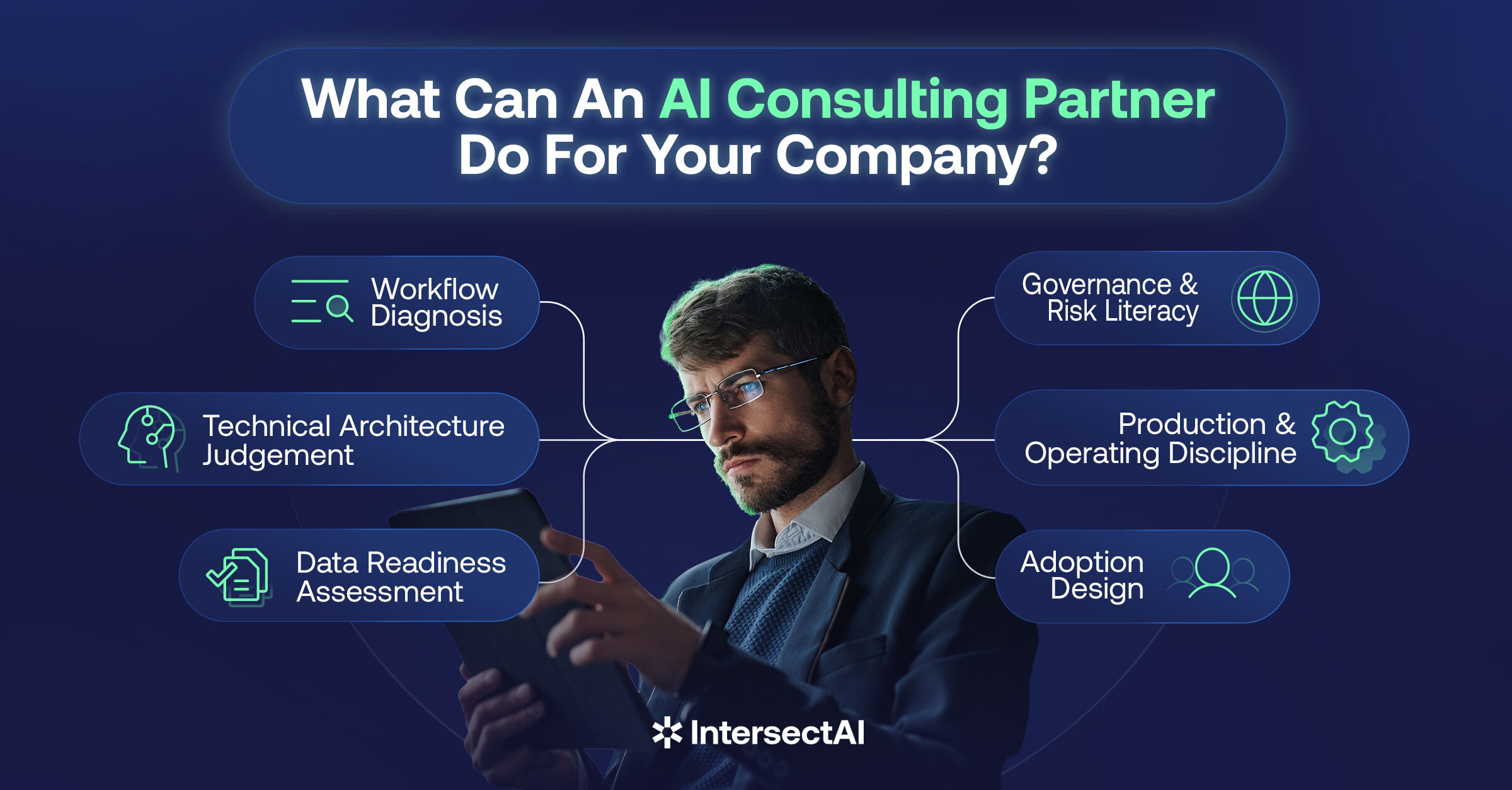

What Can an AI Consultant Do For Your Company?
Artificial intelligence (AI) is revolutionizing the business world across all departments and operations. It seems as though every month a new breakthrough is made with development and software teams claiming to have invented a new application or tool that will change everything.
But even if the tool is destined to become the greatest business asset of our time, this still isn’t enough to translate into tangible success for businesses. You could have the most powerful Large Language Model (LLM) on the planet, but it will still fail to deliver on ROI if it causes workflow friction within your team, has little in the way of governance or risk mitigation, and galvanizes employees to resist change.
This is where an AI consultant comes in.
In this article, we’ll be exploring exactly what an AI consultant does and why they’re becoming a vital asset within business hierarchies. We’ll cover the key deliverables an AI Consultant develops for businesses as well as the types of engagement models they will often follow. We’ll end with some questions on how to identify a successful AI consulting partner to bring on board.
Why Companies Need An AI Consulting Partner in 2026
It’s no secret that businesses are turning to AI consultants on a more consistent and frequent basis. Research has indicated that up to 78% of Fortune 500 companies employ at least one AI consultant specialist, a rise of 23% in just two years.
A consultant’s entire value proposition is their curated knowledge. They filter the signals from the noise of AI trends and phases, ensuring that businesses don’t invest millions into a proprietary architecture that will likely be rendered obsolete in a matter of months.
They also act as the professional agitators. Businesses often fall into the trap of keeping it the same just because that’s the way it’s always been done. Even within the world of AI (which is still a relatively new phenomenon), an AI program that’s been tried and tested for two or three years can become difficult to let go of, even if far more optimal solutions have arrived in the interim.
An outside perspective will often help to identify:
- Invisible opportunities: Novel possibilities to solve known or unknown problems, often acknowledged as a cornerstone capability of AI.
- Troublesome bottlenecks: The impact of inefficient manual processes that your team has accepted as normal.
- Data silos: Critical information that is trapped behind departmental politics.
- Misaligned goals: A clarity over whether the business is chasing cool AI or profitable AI.
Ultimately, external consultants come with structural urgency. Their engagement is defined by milestones and positive ROI, so they are incentivized to move a project forward towards a decision because their reputation often depends on tangible, measurable outcomes.
What an AI Consultant Does (And How They Help)
The role of an AI consultant has evolved over the years from an individual whose goal it was to brainstorm AI ideas to a fully-fledged business surgeon. Their work often overlaps across departments as AI is not usually confined to just one business operation.
Below are some core examples of the high-value work that AI consultants are expected to accomplish.
Diagnosing Workflows, Not Tech Opportunities
Many consultants won’t pay too much attention to the actual AI applications and programs that a business is using. Instead, they will examine how those applications are (or are not) contributing to workflow friction. Things like redundant handoffs, manual data entry practices, human error and rework are all areas commonly targeted by AI consultants.
Rather than asking where AI can be added into infrastructure, their goal is more akin to where the value of the AI is not being fully realized.
Translating Business Outcomes Into AI Requirements
All business leaders will have certain goals and outcomes that they wish to accomplish. Their focus is often on things such as margins, website churn rates, and speed of service.
AI consultants focus much more on the contextual requirements that are needed in order to achieve the business goal. They will consider aspects such as the most appropriate data sets to use, which tools are best for the job, and the guardrails that are considered to be no-go zones for AI agents.
They are also likely to pay close attention to the human-in-the-loop principle whereby human agents always have final approval of AI actions.
Selecting Optimal Solutions
AI consultants are experts across all forms of AI-powered solutions. As a result, they are well-positioned to offer hybrid strategies to tackle business objectives, often within existing infrastructure.
They may recommend ways to boost productivity within existing apps, suggest ways to bring in automated processes, or design the building blocks that will eventually facilitate agentic AI within the business.
Designing for Production
Many pilot projects fail because they are built in a vacuum without much consideration as to how it might fit into wider infrastructure. An AI consultant will ensure a solution is production-grade and often future-proofed before the first line of code is written. Factors such as security and privacy, monitoring for AI hallucinations and drifting, and backup mechanisms are all accounted for.
Transferring Capability
An effective AI consultant will never look to stay around permanently. They will design clear protocols and processes behind for the business to use once they leave the company. Internal standards, custom templates and team training are all developed and organized to ensure a smooth transfer of operations.
Key Deliverables to Expect (And Why They Matter)
It’s no longer enough for an AI consultant to simply be on hand to offer advice. Businesses have a right to expect that the time and investment they put into a consultant will eventually result in tangible results that will benefit the business over the long-term.
So what could you, as a business, expect to walk away with when opting to work with an AI consultant?
- AI Readiness & Opportunity Assessment
- A maturity snapshot: An honest appraisal of your people, current processes, data health, and existing tech stack.
- A constraints list: A reality check on the obstacles related to AI implementation that you might face.
- Feasibility vs ROI scoring: A matrix or comparison chart that ranks how much monetary potential there is in a given idea vs how hard it’ll be to realistically build.
- Risk tiering: A breakdown of low, medium, and high-risk projects with the specific guardrails (legal, ethical, technical etc.) required for each.
- Roadmap & Execution Plan
- Initial three-month sprint: A tactical plan for immediate wins that build momentum. This might include the development of an initial proof of concept (POC) or prototype to demonstrate validity.
- A 12-month vision: A strategic sequence of implementation milestones that align with broader business goals, including clear stakeholder requirements at each stage.
- Data & Integration
- ‘Source of Truth’ mapping: A clear overview of which datasets the AI is allowed to access and trust and what needs cleaning before it is deemed usable.
- Integration architecture: A map of necessary APIs and connectors.
- Adoption & Operation Model
- Roles and ownership: Clear definitions over who owns the AI, who maintains it, and how often it’s reviewed.
- Human-in-the-loop (HITL) protocols: Documented workflows that define when human intervention is expected for approval.
- Training documentation: The templates for operations that staff can access when the consultant is no longer employed.
Where AI Consulting is Creating the Biggest ROI in 2026
It goes without saying that if an AI consultant isn’t able to generate a positive return on investment as a result of the ideas, programs, or policies they’ve put in place, the process of bringing them onboard could be seen as a costly business failure. With AI now so prevalent in modern businesses, many consultants are upending the entire infrastructure of a business. So it’s absolutely vital that, in the end, it pays dividends.
Here are six of the main areas where AI consulting is delivering the most significant measurable value in 2026.
Customer Support and Escalation
Beyond simple chatbots, consultants are deploying agentic systems that gather deep context and draft complex resolutions before a human even opens a ticket. This has dramatically increased autonomous resolution rates for leading firms, lowered the Cost per Incident rate, and improved customer satisfaction scores (CSAT).
Finance Operations
Consultants help finance teams move away from manual invoicing and matching. By integrating Intelligent Document Processing (IDP), companies are reducing payment cycle times and allowing analysts to focus more on predictive cash flow modeling rather than data entry.
Compliance & Risk Management
Consultants are helping to build evidence-based workflows to combat expected audit preparation times. Automated processes are making the processes far more robust. They will also make sure that ‘high-risk’ AI systems remain continuously compliant and documented.
Employee Onboarding
Coordinating HR, IT, and finance for a new hire is often a headache. Consultants use AI to orchestrate and streamline these departmental handoffs to ensure a zero-day productive start for every employee. Tasks such as automated equipment provisioning, background checks, and payroll setup are common targets for AI onboarding processes.
IT Service Desk Triage
Modern consulting focuses on multi-agent orchestration (or an AI/human hybrid approach) where AI acts as the first responder for tickets. By diagnosing and triggering corrective actions, IT teams have seen a massive reduction in their overall mean times for resolution.
Optimizing Manual Workflows
Many of the most important wins that a consultant can deliver come from the invisible work that is often taken for granted. Consultants can design systems that will extract unstructured data from messy threads and sync it directly to CRMs and ERPs. This will help to reduce email response times within client-facing departments.
How to Choose the Right AI Consultant
As we move through 2026 and beyond, the number of people moving from traditional consultancy roles into AI-related positions is only going to increase. And with this, you will likely see the inevitable rise of people who may claim to be experts but who will likely wilt under the first sign of scrutiny.
So how can you be sure that the AI consultant you hire is legitimate and the right person for your business?
We’ve put together a list of probing questions that a talented AI consultant should be ready to answer:
Show me a production example - what changed from pilot to production?
Expert consultants will be able to make the move from prototyping and experimentation via vibe coding into actual production, complete with edge cases, latency issues, and unexpected bugs.
‘How do you handle data readiness and ‘Source of Truth’ problems?’
A good consultant will be able to talk you through how they ascertain whether a database is AI-ready, data cleaning processes, and how they handle conflicting information across silos.
‘How do you set permissions, guardrails, and audit trails?’
These are all vital steps towards security, compliance and accountability within the business. A consultant should have strategies in place for all of them
‘How do you evaluate performance, catch failure modes and drift?’
Models will degrade and become outdated over time, which could end up disrupting vital business operations. You need to be sure your consultant has accounted for this.
‘How will you integrate with our existing tech stack?’
A great consultant focuses on deep integration rather than endless add ons to current infrastructure. AI Systems and Solutions should be deployed and integrated in a way that fits with the corporate IT strategy. They should leverage existing systems where possible, and help move a company toward the reference architecture."
Closing Thoughts
In 2026, we will likely continue to see the gradual decline of AI adoption and experimentation and a greater move towards established AI infrastructure. AI consultants will remain a key component of the goal for repeatable, reliable, and deeply operational AI programs and applications.
By choosing to work with an AI consultant, the ultimate win for your business will be defined by fewer bottlenecks, faster decision-making, and ironclad consistency without the risk of upending your existing systems.
At Intersect AI, we specialize in bridging the gap between new tech and measurable business value, building architecture to allow your company to run on intelligence. We move our customers past pilot purgatory and turn AI potential into a permanent competitive advantage, future-proofing businesses against what comes next.
Get in touch to begin your AI integration journey today.
FAQs
Do we need an AI consultant if we already have IT teams?
IT specialists play a very different role within a business than AI consultants; these individuals are often experts at keeping existing infrastructure and operations running smoothly. However, if you want to innovate and take advantage of the ever-changing AI landscape, a consultant is your best bet.
How long before we see an ROI?
A structured engagement may take between 6-12 months to show signs of ROI. However, this is heavily dependent on the scale and complexity of the adoption and transition.
What should we fix before we start to work with a consultant?
To make things as streamlined as possible, we recommend that you integrate your data as much as possible into a single Source of Truth before the consultant arrives. Make sure all of your existing processes are fully documented, with clearly identifiable workflows. And ensure your CRM is validated.
Will AI adoption replace jobs or augment teams?
AI is augmenting far more than it is replacing. Human agents are moving away from manual data entry itself and towards higher-level oversight roles and many AI processes still favour human-in-the-loop components. The ultimate goal of AI adoption is to steer your human workforce towards valuable rather than mundane tasks.