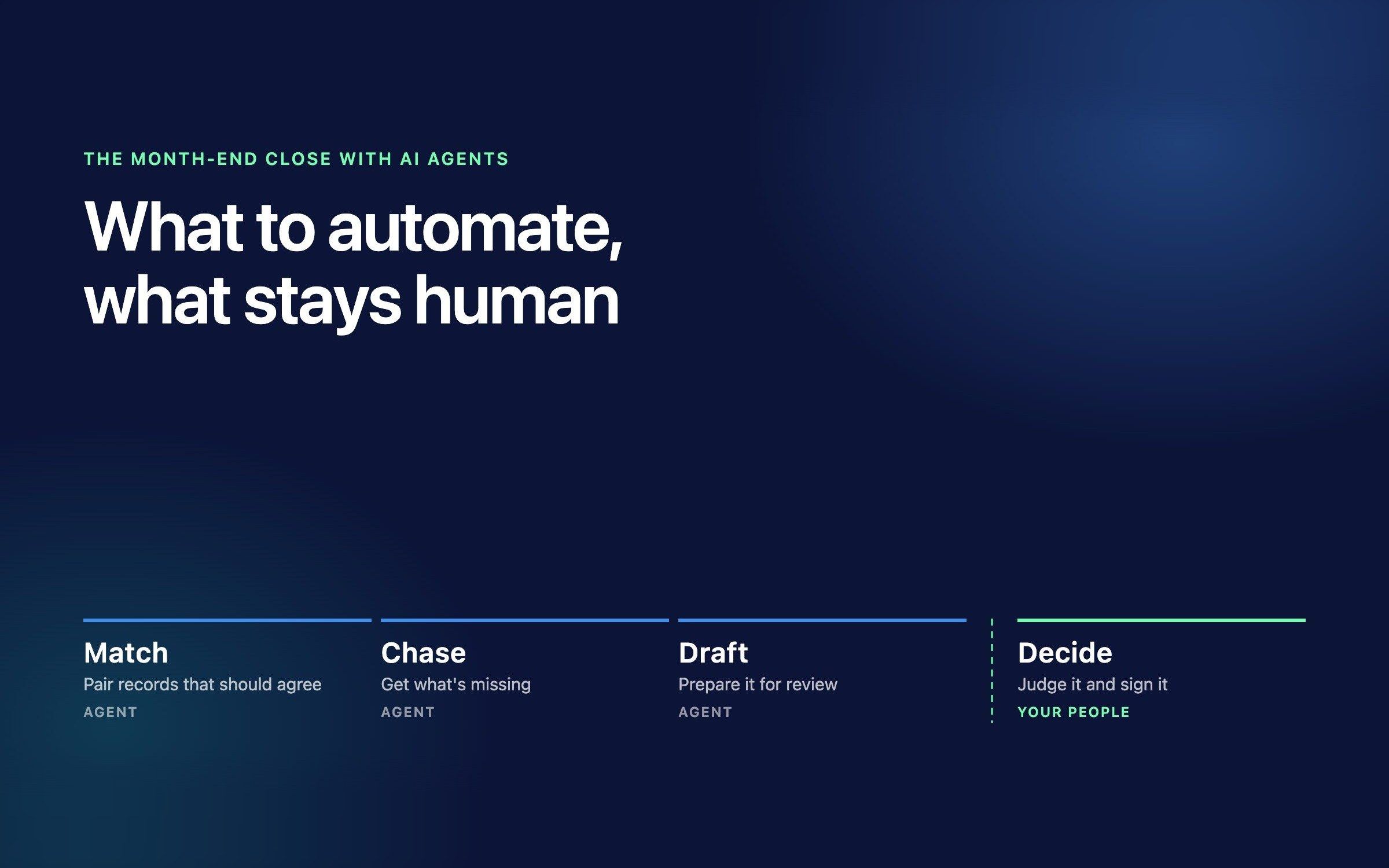

The short answer: AI agents can do most of the month-end close, but not all of it. Give them the matching (bank, balance sheet and intercompany reconciliations), the chasing (missing invoices, unexplained items, late cut-off data) and the first draft of journals and variance commentary. Keep the judgements, like estimates and write-offs, and the sign-off with people. We call this split match, chase, draft, decide.
Why hasn't AI made the close faster yet?
Most finance teams already use AI. They just don't use it on the close. In a 2026 survey by finance software firm LiveFlow, about 80% of finance professionals said they use AI for drafting and 65% for financial analysis, but only 23% use the AI built into their finance systems (CFO Dive, May 2026).
Meanwhile the close is still stuck on the same things. Nearly eight in ten respondents said it's delayed by waiting for data from other systems or departments, and more than half named reconciling across platforms. Only 16% close in under three days.
So AI went to the wrong end of the close. It writes the board memo, while someone still ticks off bank lines and emails the warehouse about a missing goods receipt.
The opposite mistake is now just as common: buying the promise of a close that runs itself. When Mercor and Ramp tested nine frontier models on 160 real close tasks in July 2026, the best one passed 56% of the expert grading criteria (Mercor). Their own conclusion was that no model can reliably close the books.
The right answer sits between those two. It's set by the kind of work in each task, not by where the task sits on the checklist.
Which close tasks can AI agents automate?
Agents can automate the close tasks that are matching, chasing or drafting, and none of the ones that need a decision. Every task on a close checklist is some mix of four kinds of work. Sort by those, not by step, and the split becomes obvious.
- Match (agent): pair records that should agree. Bank lines to the ledger, invoices to orders and receipts, one entity's intercompany balance to the other's.
- Chase (agent): go and get what's missing. The unmatched payment, the late invoice, the explanation for a journal nobody recognises.
- Draft (agent): produce a first version with the evidence attached. Accrual schedules, journals, reconciliation workpapers, variance commentary.
- Decide (your people): make the call that needs judgement or accountability. Estimates, write-offs, whether a variance matters, and the sign-off.
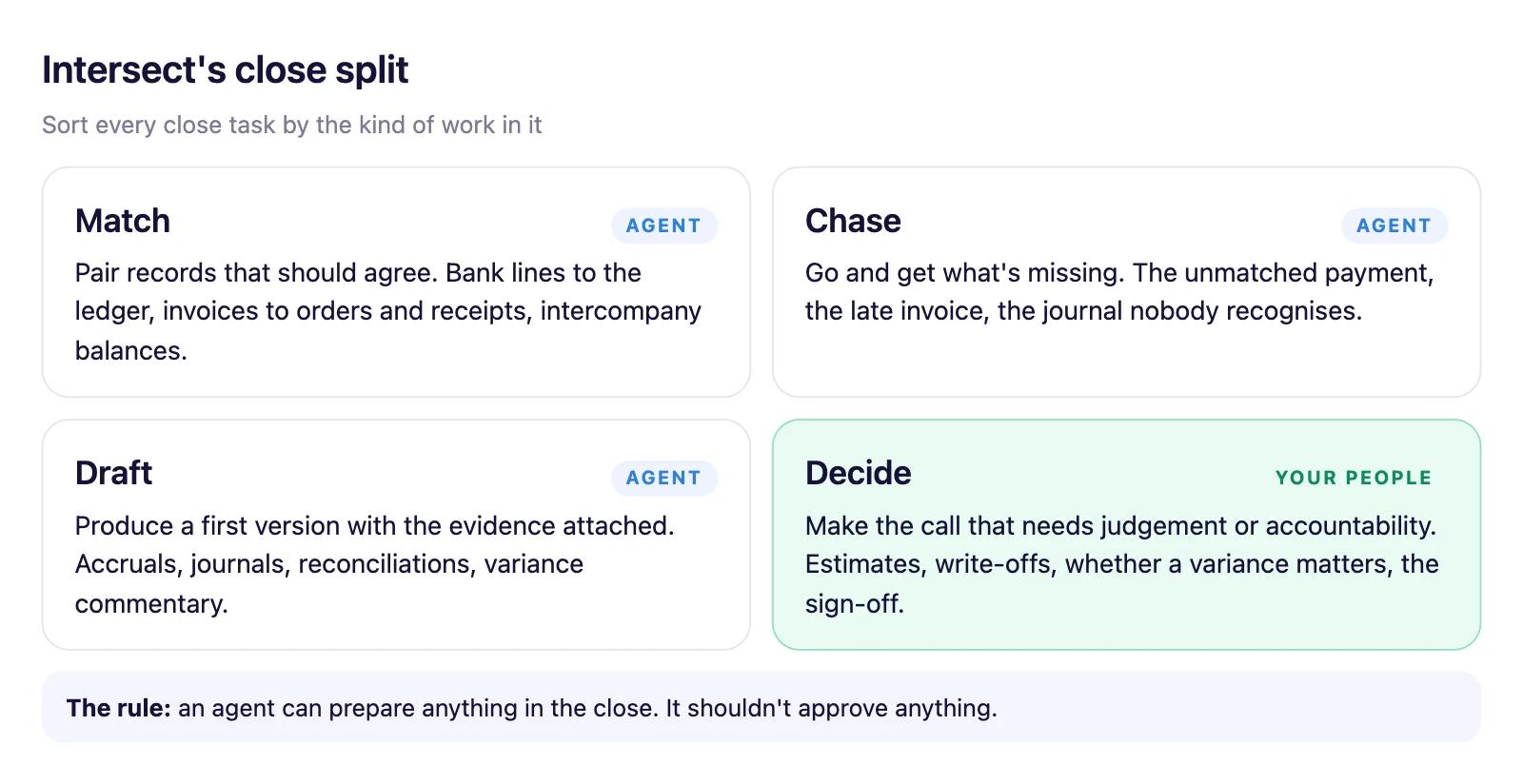
We call this Intersect's close split. Agents take the first three verbs and a person keeps the fourth. The line that matters is the one between draft and decide.
An agent can prepare anything in the close. It shouldn't approve anything.
The evidence so far supports that split. A Stanford study of 79 small and mid-sized businesses on an AI accounting platform found AI use was associated with a monthly close 7.5 days shorter. Accountants also stepped in more often when the AI flagged low confidence (Choi and Xie, Stanford GSB, 2025). The time came back from routine work. The people stayed on the calls.
The close checklist, split between agent and person
Here's a standard close checklist with the split applied, step by step.
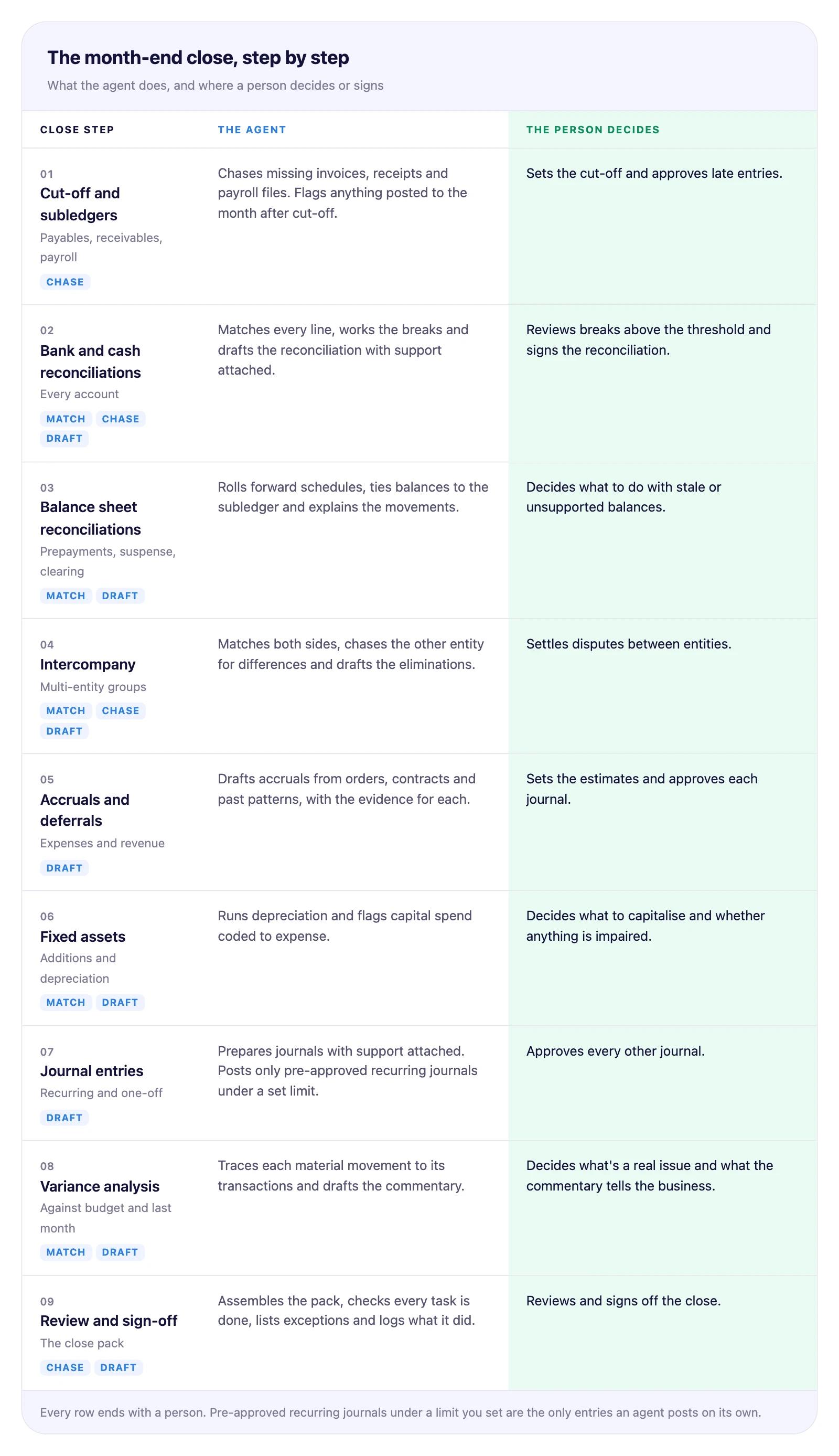
How each close step works with an agent
Four steps carry most of the hours and most of the risk. Each one below covers what the agent does, what it touches, the guardrail, what to measure and where it fails.
Reconciliations
- The agent: Matches bank, card and balance sheet lines to the ledger every day, not just at month-end. Then it works the breaks: finds the likely match, asks the person who'd know, and attaches the answer to the reconciliation.
- Touches: Bank feeds, the accounting system or ERP, the accounts payable inbox.
- Guardrail: It proposes matches inside a tolerance you set. It can't clear a break by posting a journal.
- Measure: Share of lines matched with no human touch, and open breaks on day one of the close.
- Where it fails: Bulk payments with no remittance, and accounts where the right answer lives in one person's head.
Accruals
- The agent: Builds the accrual list from open purchase orders, contracts, recurring suppliers and last month's pattern. It drafts each entry with the evidence behind it.
- Touches: Purchase orders, contracts, payables, prior-period journals.
- Guardrail: It drafts. A person sets every estimate and approves every journal.
- Measure: How often, and by how much, next month's true-up corrects the accrual.
- Where it fails: Spend nobody raised an order for, and estimates that depend on a conversation with the business. That's decide work.
Variance commentary
- The agent: Runs the comparison against budget and last month, traces each material movement to the transactions behind it, and writes the first draft of the commentary. An example draft line: "Professional fees are over budget because two legal invoices for the lease renewal landed this month."
- Touches: General ledger, budget, subledgers, sometimes the CRM or HR system.
- Guardrail: Every sentence links to the transactions it cites. Nothing goes in the pack unreviewed.
- Measure: Time from close to management pack, and how much of the draft the controller rewrites.
- Where it fails: It can explain what moved, not whether that's a problem. "One-off or the start of a trend?" is a question for a person.
Approvals and sign-off
- The agent: Assembles the close pack, checks every task and reconciliation is complete, lists the exceptions, and logs what it did and why.
- Touches: The close checklist and the agent's own activity log.
- Guardrail: It never approves its own work, and it has no approval rights in the ledger.
- Measure: Days to close, and post-close adjustments.
- Where it fails: Without a complete log, your auditor has nothing to test, and the time you saved comes back at year-end.
How do you keep controls in place?
Treat the agent as a preparer, never as an approver. Your segregation of duties already says the person who prepares a reconciliation can't approve it. The same rule covers the agent.
COSO's February 2026 guidance on internal control over generative AI points the same way. It sorts AI uses into eight capability types, including posting and judgment, each with its own control expectations (Journal of Accountancy). Posting and judgement are the two things the close split keeps with people.
- Give it a junior's access. Read, draft and propose. Posting rights only for pre-approved recurring journals under a limit you set.
- Log everything. What it looked at, what it produced, which model version, and who reviewed it. That log is your audit evidence.
- Agree the evidence with your auditor first. Deloitte's guidance on the COSO framework says to settle what counts as sufficient evidence with internal and external auditors early (Deloitte). Do it before the first live close, not after it.
- Run two closes in parallel. The agent and the team both do the work, and you compare. Switch over when the differences are ones you'd accept from a new hire.
When doesn't this work?
When nobody reviews the drafts. In the Mercor and Ramp benchmark, the best result for getting a task fully right on all eight attempts was 2.6%, and 58% of tasks were never fully solved by any model on any run. Most failures were reasoning errors: a model would spot a discrepancy early, then contradict it in its final journal (Mercor, July 2026). Both companies sell into this market, so read it as a stress test. But it's why drafts get reviewed.
When the data isn't in a system. An agent can only chase what it can reach. If cut-off data arrives as a photo of a delivery note, fix that first.
When the books are small. With 40 bank lines a month, a person matches them faster than you can set an agent up.
When you've just migrated systems. The first close on a new ERP is the wrong time to change who does the work.
And the review time doesn't disappear. It moves. Your team spends less time preparing and more time checking, and the checking has to be real. A controller who signs off agent work without reading it has the same problem as one who signs off a junior's work without reading it.
What to do next
Take last month's close checklist. Next to each task, write which of the four verbs it is, and roughly how many hours it took. Most teams find match and chase account for the bulk of the hours.
Pick the match-and-chase task that eats the most time. For most teams it's bank and balance sheet reconciliations. Run an agent on it in parallel for two closes. Leave everything marked decide exactly where it is.
Want to know which of your close tasks an agent could take? Book a call and we'll go through your close checklist with you, step by step, and mark where the split falls. Our AI Development Studio builds and runs finance agents with the review steps built in.
FAQ
Can AI do the month-end close on its own?
No. Current agents can do most of the preparation, but they aren't consistent enough to close the books unsupervised. In the July 2026 APEX-Accounting benchmark, no model fully solved a majority of close tasks reliably. Use agents to prepare and people to decide.
Will AI agents replace the controller?
No. They replace the matching and chasing that fill the first days of the close. The controller's job moves towards review, judgement and explaining the numbers, which is the part the business actually needs from them.
How much faster will our close get?
It depends on how much of your close is matching and chasing. The Stanford field study found a 7.5-day shorter close among AI users, and Gartner predicts a 30% faster close by 2028 for teams on cloud ERP with embedded AI (Gartner). In our view, most of the gain comes from reconciling during the month, so the close starts half-done.