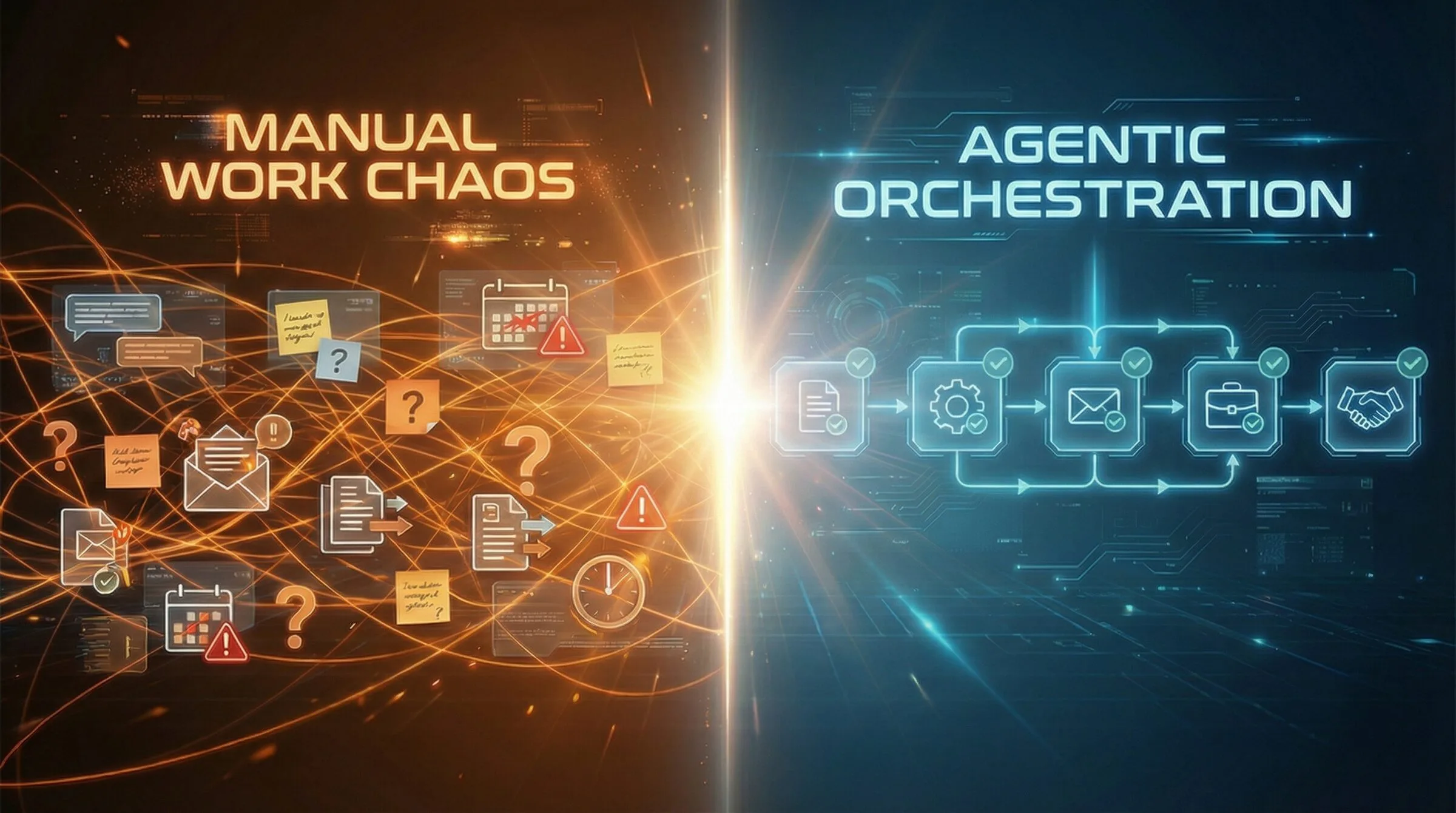

The Hidden Cost of Manual Work and How an Agentic Workforce Reduces It
With data flowing between departments and priorities shifting daily, modern enterprises are busier than ever.
But busy does not mean efficient.
Across finance, HR, operations, sales, compliance, and IT, highly skilled employees are still spending a significant portion of their time on manual, repetitive, process-driven tasks. Copying data between systems. Chasing approvals. Drafting similar documents. Reconciling spreadsheets. Routing work to the next team.
Individually, these activities feel routine. Collectively, they create a structural cost layer that most businesses underestimate.
Manual work quietly consumes labour budget, fragments focus, increases error rates, and slows execution.
Traditional automation has reduced some of this burden by handling isolated tasks.
But point solutions do not remove the human effort required to move work across systems and teams.
An agentic workforce represents the next step.
Instead of automating one task at a time, agentic AI systems execute workflows end to end. They plan, route, validate, follow up, and escalate only when human judgment is required.
The result is not just efficiency gains. It is structural operating leverage.
In this article, we explore what manual work looks like inside modern enterprises, where the real costs accumulate, and how an agentic workforce reduces those costs without replacing your existing technology stack.

What Manual Work Looks Like Day to Day
It is 2026. Your systems are modern. Your teams are capable.
And yet manual work persists.
- A finance analyst exports ERP data into Excel to reconcile invoices.
- A HR manager emails IT to provision system access for a new hire.
- A sales team copies CRM notes into a proposal template.
- A compliance officer manually checks contracts against policy criteria.
- A support agent searches across multiple knowledge bases to resolve a ticket.
None of these tasks require strategic thinking. But they require time.
Multiply those minutes across hundreds of employees and thousands of transactions, and manual work becomes one of the largest invisible cost centres in the organisation.
The issue is not inefficiency at the individual level. It is structural reliance on humans to execute repeatable workflows.
The Cost of Manual Work – Where It Appears on the Balance Sheet
Manual effort shows up in more places than most leaders realise.
Direct Labour Cost
When experienced professionals spend hours on repetitive processing, the business pays premium rates for low-leverage output. If five employees earning $100 per hour spend just 10 hours per week on manual reconciliation or status reporting, that equates to $5,000 per week redirected away from strategic value creation. Across departments, this compounds rapidly.
Cognitive and Context Switching Cost
Manual tasks rarely occur in isolation. They interrupt deeper work. Research shows that after an interruption, it can take over 20 minutes to regain focus. Fragmented attention reduces both speed and quality of output.
Rework and Error Cost
Manual copy-and-paste workflows introduce duplication, version confusion, and compliance risk. Data lives in multiple systems. Small discrepancies cascade into larger corrections. Hours are spent fixing avoidable mistakes.
Cycle Time and Opportunity Cost
Manual routing and approval steps create lag between each stage of a process. Time-to-market extends. Opportunities close before execution catches up. Speed is competitive advantage. Manual effort erodes it.
Risk Cost
When workflows depend on individuals remembering to take the next step, accountability becomes blurred. Auditing becomes difficult. Small lapses escalate into operational or compliance failures.
These costs rarely appear as a single line item. They diffuse across payroll, delays, missed opportunities, and risk exposure.
Workflows Where Manual Tasks Hurt Most
Not all functions experience manual burden equally.
The impact is highest in workflows that are cross-functional, time-sensitive, and high-volume.
- Employee onboarding, where HR, IT, payroll, and compliance must align.
- Procurement, requiring finance, legal, and security approvals.
- Finance reconciliation and reporting.
- Customer support escalation.
- Incident response and security management.
- Lead qualification and sales follow-up.
In these environments, manual effort compounds quickly and slows the entire organisation.
How High-Performing Enterprises Reduce Manual Overhead
High-performing enterprises still use meetings and communication tools. But they design workflows differently.
They prioritise:
- A single source of truth across departments.
- Clear ownership and accountability structures.
- Standardised inputs and outputs.
- Event-driven workflows triggered by status changes rather than manual follow-up.
- Automation for repeatable logic-based tasks.
This foundation allows them to move beyond fragmented automation toward an agentic workforce.
What an Agentic Workforce Is
An AI agent is a system capable of executing repeatable tasks based on defined rules, objectives, and data inputs.
An agentic workforce links multiple agents together into orchestrated workflows that operate across systems.
Instead of a human initiating each step, the workflow executes autonomously.
For example:
- When a contract is signed, the system generates the client folder, updates the CRM, provisions system access, creates the invoice, notifies finance, and schedules onboarding. Humans intervene only if an exception arises.
- In finance, agents reconcile invoices and draft vendor enquiries automatically.
- In HR, agents coordinate onboarding across systems.
- In IT, agents triage tickets and provision access based on policy.
- In customer support, agents analyse context and propose next-best actions.
This is not task automation. It is workflow ownership.
Why Agentic Systems Reduce Manual Cost Structurally
Traditional automation follows fixed rules within one system. Agentic systems operate with objectives across systems.
They:
- Gather missing information.
- Trigger subsequent actions.
- Detect exceptions.
- Maintain context.
- Escalate intelligently.
This removes the need for humans to manually push work from one stage to the next.
As manual touchpoints decrease, labour shifts from processing to decision-making.
How to Get Started
The transition to an agentic workforce does not require replacing your existing technology stack.
It begins by identifying workflows where:
- Manual effort is high.
- Volume is consistent.
- Rules are defined.
- Judgment is limited to exception cases.
Strong initial use cases include invoice reconciliation, onboarding coordination, ticket triage, compliance checks, reporting workflows, and lead qualification.
Before implementation, capture baseline metrics:
- Hours spent per workflow
- Cost per task
- Time to completion
- Error rate
- Number of human touchpoints
Reduction in human touchpoints is often the clearest signal of structural improvement.
Closing Thoughts
Manual work is not a sign of poor employees.
It is a sign of outdated workflow design.
As enterprises grow, systems multiply. Humans fill the gaps between them. Over time, those gaps become expensive.
An agentic workforce closes them.
- It reduces labour cost without reducing headcount.
- It shortens cycle time without increasing pressure.
- It improves compliance without adding bureaucracy.
Most importantly, it reallocates human time toward work that genuinely requires human intelligence.
The future of enterprise efficiency is not more process. It is fewer manual steps.
And that is what an agentic workforce enables.