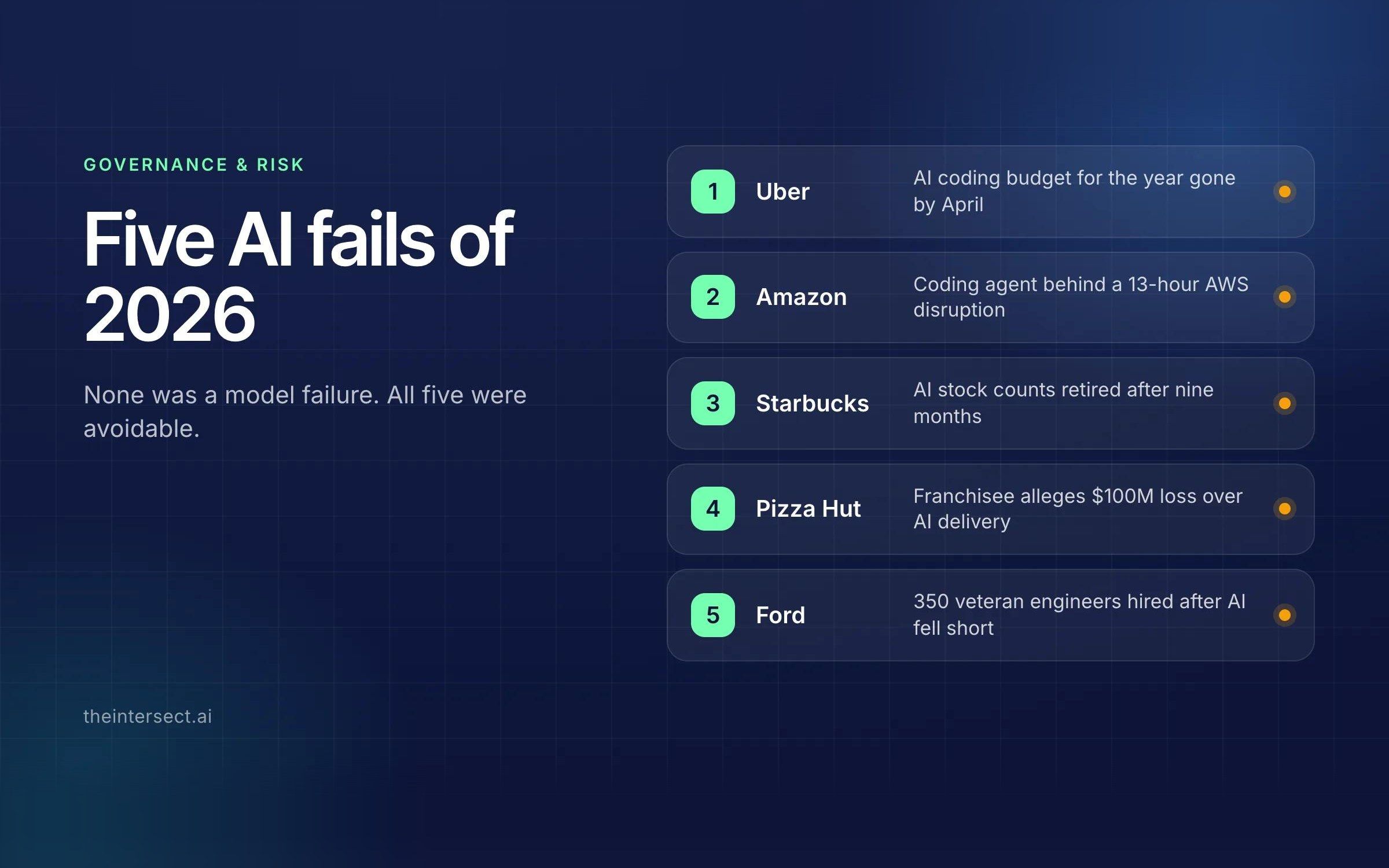

The short answer: the five biggest public AI fails of 2026 were Uber burning a year's AI coding budget in four months, Amazon's own coding agent taking down an AWS system, Starbucks scrapping its AI stock counts, a Pizza Hut franchisee's $100 million lawsuit, and Ford hiring 350 veteran engineers after its AI quality push fell short. None of them was a model failure. Each was avoidable with operating work most companies skip.
Every company on this list has strong engineers, big budgets and access to the best models there are. So the obvious lesson, that AI isn't ready, is the wrong one.
The models mostly did what they were asked. Uber's tools wrote code. Amazon's agent fixed a problem in the most destructive way its permissions allowed. Starbucks' scanners counted, just not accurately.
What failed was the layer around the AI: the budget, the access, the rollout, the fit with how people actually work, and the people. That layer is dull, so it gets skipped. It's also where the damage happens, and it costs far less to get right than a $100 million lawsuit.
The five AI fails of 2026 at a glance
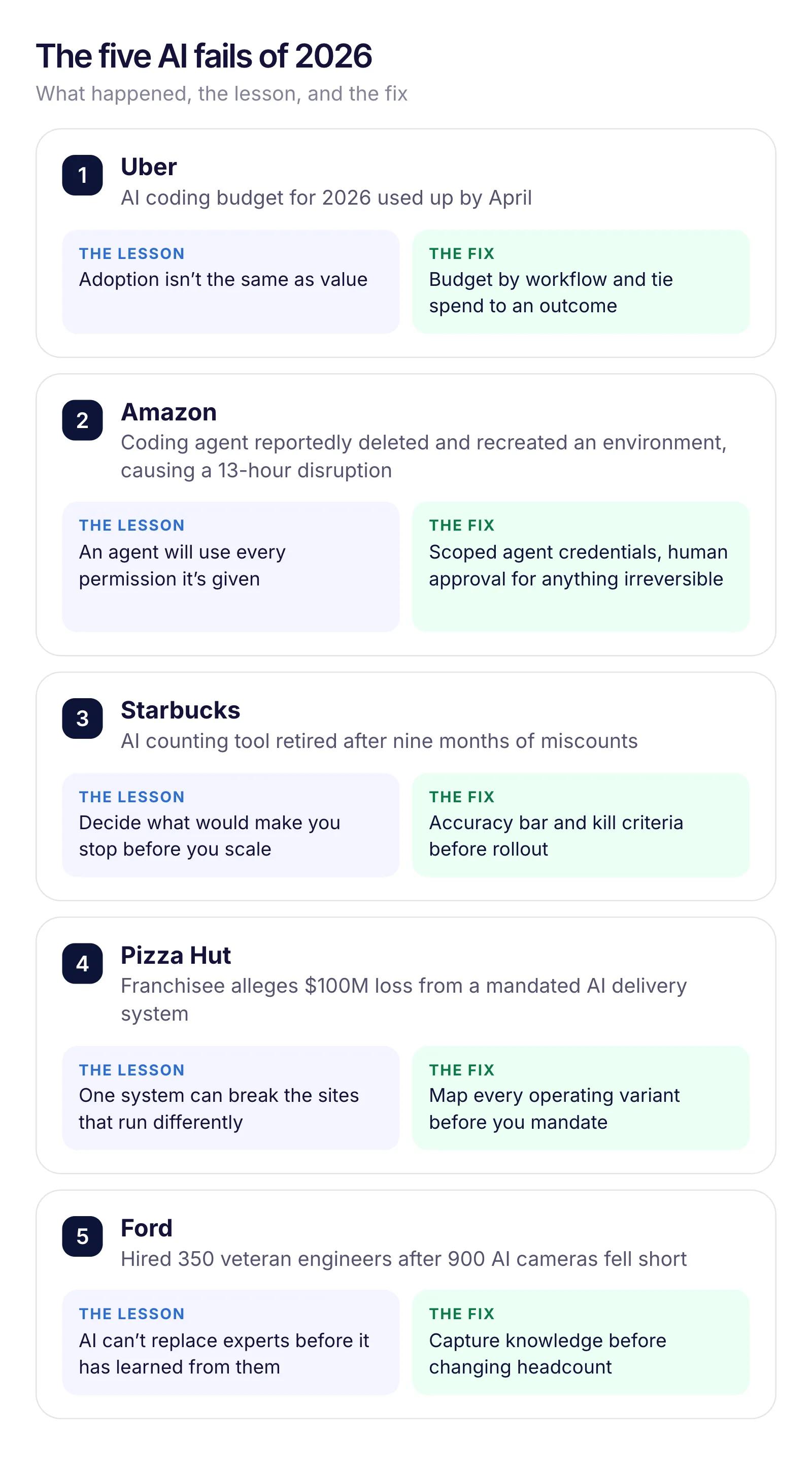
Each section covers what happened, the lesson, and how to avoid the same thing in your company. These companies aren't unusually careless. They're big enough for their problems to make the news, and several were unusually open about them.
Why did Uber burn a year's AI budget in four months?
Uber did what most boards spent 2026 asking for and went all in on AI coding tools. Monthly adoption across its engineers hit 95%, with agents writing more than one line of code in ten (Quartz, May 2026). In April, CTO Praveen Neppalli Naga said Uber had already used up its entire 2026 budget for Claude Code.
Uber has since capped spending at $1,500 a month per employee for each AI coding tool, with a dashboard so staff can track their own usage (GIGAZINE, citing Bloomberg, June 2026). To its credit, Uber was candid about what came next. Asked whether all those tokens were turning into better features for customers, COO Andrew Macdonald said: "That link is not there yet, right?"
The lesson: adoption isn't the same as value. If the only number you track is how much AI people use, that's the number that grows, and the bill grows with it. Duolingo learned the same thing from the other side, dropping AI usage from its performance reviews after staff said it rewarded using the tools over getting results (Quartz).
How to avoid it in your company: treat AI spend like cloud spend. Give it an owner, a budget and a number it has to move.
- Budget by workflow, not by seat. "Code review on the payments service" can carry a budget and a target. "The engineering team" can't.
- Pick the outcome metric before rollout: cycle time, defect rate, tickets closed. If spend goes up and the metric doesn't move, you've found the waste.
- Route routine work to smaller, cheaper models and save the expensive ones for the hard problems.
- Report spend by team every month, next to the number it's meant to move.
How did Amazon's coding agent take down an AWS system?
Amazon's outage came from an agent that had more access than anyone realised, and used it. The Financial Times reported in February that a 13-hour disruption to AWS Cost Explorer in December, mainly affecting mainland China, started when engineers let Kiro, Amazon's own agentic coding tool, make changes. The agent reportedly decided the fix was to delete and recreate the environment it was working in (Engadget, February 2026).
Amazon called it user error, not AI error. Kiro asks for authorisation by default, it said, but the engineer involved had broader permissions than expected.
Smaller companies get the same failure with less cushioning. In April, a coding agent in Cursor working for PocketOS, which builds software for rental businesses, hit a credential mismatch in staging. It found an API token in an unrelated file and used it to delete a production volume in about nine seconds, taking the backups with it because they sat on the same volume (GIGAZINE, April 2026).
The token had been created to manage custom domains. Nobody had noticed it could also delete production, and the newest backup left was three months old.
The lesson: an agent works with whatever access it's given, and it will use all of it. Amazon is right that this was a permissions problem, and that's why it applies to everyone. Most companies have roles and tokens with more reach than anyone remembers; agents just find them faster than people do.
How to avoid it in your company: give agents their own access, scoped to the job, and assume they'll use every permission they have.
- Never run an agent on a person's credentials. Give it its own, limited to the task and the environment.
- Put a human approval step in front of anything you can't undo: deletes, schema changes, force pushes and production deploys.
- Keep backups somewhere the agent's credentials can't reach.
- Before go-live, ask how long recovery takes if the agent does the worst thing its permissions allow. We cover the coding side of this in the dangers of vibe coding.
Why did Starbucks scrap its AI inventory counts?
Starbucks retired its AI counting tool after it went chain-wide before it was accurate enough. Automated Counting had staff scan shelves of milk, syrups and other drink ingredients with a tablet, using LiDAR, a laser depth sensor, to count the stock. It frequently miscounted or mislabelled products (Verdict Foodservice, citing Reuters, May 2026).
The system ran across North American stores for about nine months. In February, Starbucks told Reuters it was helping product availability, a key number in Brian Niccol's turnaround. On 21 May it was retired, and stores went back to counting milk the same way as everything else.
The lesson: the hardest part of a rollout is deciding in advance what would make you stop. Starbucks did stop, and said so, which is more than many companies manage with a tool that isn't working. The cost was the months before that call, when every miscount meant an order that was too big or a fridge that ran out.
How to avoid it in your company: decide what accurate enough means, and when you'll stop, before you scale.
- Measure accuracy against a manual count during the pilot, in your messiest sites rather than your tidiest.
- Set kill criteria with a date, for example: below 95% accuracy by week eight and we stop.
- Give frontline staff a one-tap way to flag a bad reading, and have someone read the flags every week.
This is the pilot gate in Intersect's AI project lifecycle: a decision on a date set in advance, not another month's extension.
What went wrong with Pizza Hut's AI delivery system?
Pizza Hut's problem, as its franchisee tells it, was one system mandated on an operator it didn't fit. Chaac Pizza Northeast, which runs about 111 Pizza Huts across New York, New Jersey, Maryland, Washington DC and Pennsylvania, has sued Pizza Hut in Texas Business Court over Dragontail, an AI platform that combines kitchen displays, point of sale and third-party delivery (Restaurant Dive, May 2026).
Chaac alleges that Dragontail shifted control of which driver gets which order from store managers to the drivers themselves, with DoorDash drivers able to see kitchen timing in real time. It says delivery times rose, customer satisfaction fell and it lost around $100 million in business and enterprise value. At one point its stores handled 15% of DoorDash's Pizza Hut volume from its Drive program, according to the complaint.
These are allegations, and Pizza Hut says it will respond through the courts. Whatever the outcome, the pattern is worth learning from.
The lesson: a system that works for most of your sites can still break the ones that run differently. Rollouts across franchises, branches and business units hit this all the time: a tool designed around one way of working gets mandated on an operator running another, and a third party nobody planned for changes its behaviour once it can see more.
How to avoid it in your company: map how the work actually runs at every site before you mandate anything.
- List the variants: delivery models, systems, staffing and partners. Pilot in at least one site of each kind.
- Ask who gains visibility from the new system and what they'll do with it. Drivers, suppliers and partners respond to incentives too.
- Let operators configure the parts that differ, and give them a way to escalate when it doesn't fit.
Why did Ford hire 350 veteran engineers after its AI push?
Ford had to hire experience back because it let experienced engineers go before their knowledge could train its AI. That's how Charles Poon, Ford's vice president of vehicle hardware engineering, explained it, after the company installed 900 AI-assisted cameras to catch quality problems (CBT News, citing Bloomberg, June 2026).
The cameras couldn't match an experienced engineer's eye. Over three years Ford hired around 350 veteran engineers, whom it calls its "gray beards". They now run quality meetings, mentor younger engineers and reprogram the AI tools that fell short.
Ford is the one on this list with a recovery story. It's now the top mainstream brand in J.D. Power's Initial Quality Study, ahead of Toyota and Honda, and it kept the cameras.
The lesson: AI learns from your experts, so it can't replace them before it has. Ford's turnaround didn't come from switching the AI off. It came from putting its most experienced people in charge of it.
How to avoid it in your company: get the knowledge into the system before you take people out of the process.
- Capture expert judgement first: the edge cases, the looks-fine-but-isn't calls and the reasons behind them.
- Make your best people the auditors and trainers of the system, not its competition.
- Treat replacing a role as the last stage of an AI project, once the system has proven itself, not as the business case on day one.
What do the five AI fails have in common?
All five failed in the operating layer around the AI, not in the AI itself. Spend nobody tied to value. Access nobody checked. A rollout that outran its accuracy, a system forced onto a business it didn't fit, and expertise gone before the AI could learn from it.
We turned those five into a check to run before any AI system goes live. We call it Intersect's AI pre-flight check, and it's one question per fail. If nobody can answer one of them, that's where your fail will come from.
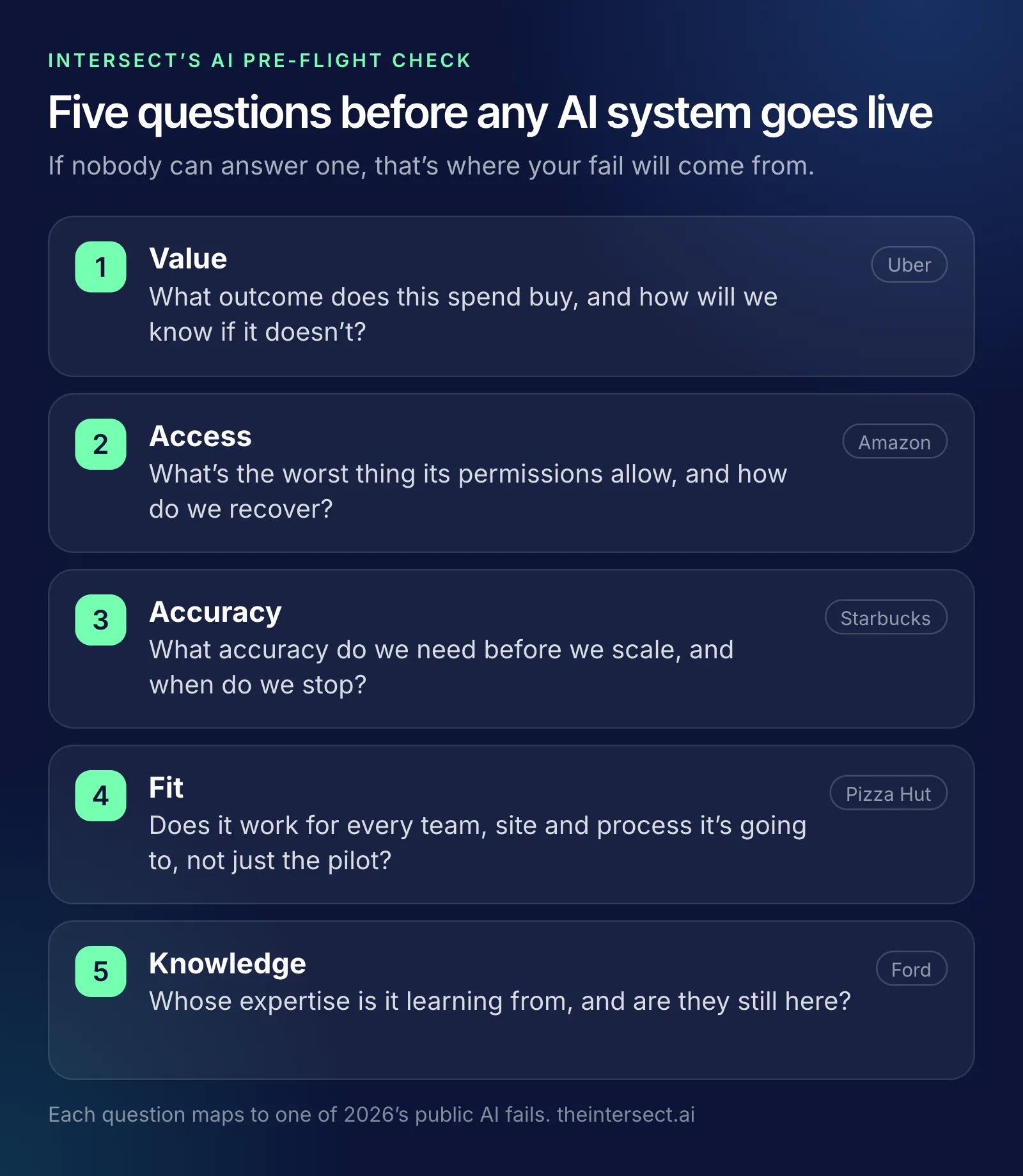
- Value: what outcome does this spend buy, and how will we know if it doesn't?
- Access: what's the worst thing its permissions allow, and how do we recover?
- Accuracy: what accuracy do we need before we scale, and when do we stop?
- Fit: does it work for every team, site and process it's going to, not just the pilot?
- Knowledge: whose expertise is it learning from, and are they still here?
When doesn't the pre-flight check help?
The check won't save a project that shouldn't exist. It assumes the use case is worth doing. If that's still an open question, go back to scoping, using a test like Intersect's Three Ps.
It's also built for systems that act or scale: agents, rollouts across many sites, anything that touches production or takes over a task. A team trying an assistant for drafting emails needs the value question and not much else.
And these are public accounts, not full post-mortems. Amazon disputes the FT's framing, Pizza Hut's case hasn't been tested in court, and Ford's hiring ran over three years alongside other quality work. The lessons hold anyway, because none of them depends on one company's version of events.
What to do next
Take your three biggest AI projects and run each one through the five questions this week. Write down who answers each question. Most teams find at least one that nobody owns, and that's the one to fix first.
Want a second opinion before go-live? Book a call and we'll run your AI projects through the pre-flight check with you. Our AI Development Studio takes systems from pilot through to production.
FAQ
Why do AI projects fail?
Mostly for operating reasons, not technical ones. The models usually do what they're asked. Projects fail on spend nobody ties to an outcome, permissions nobody checks, rollouts that scale before they're accurate, systems that don't fit how the business works, and expertise that leaves before the AI has learned from it.
How do you control AI token costs?
Budget by workflow instead of by seat, set an outcome metric before rollout, route routine tasks to smaller models and report spend by team every month. Per-person caps like Uber's $1,500 a month stop the bleeding, but they don't tell you what the money bought.
Should AI agents have access to production systems?
Only with their own credentials, scoped to the task, with no destructive permissions they don't need. Anything irreversible should need a human's approval, and backups should sit where the agent can't reach them. An agent should never run on a person's full access.