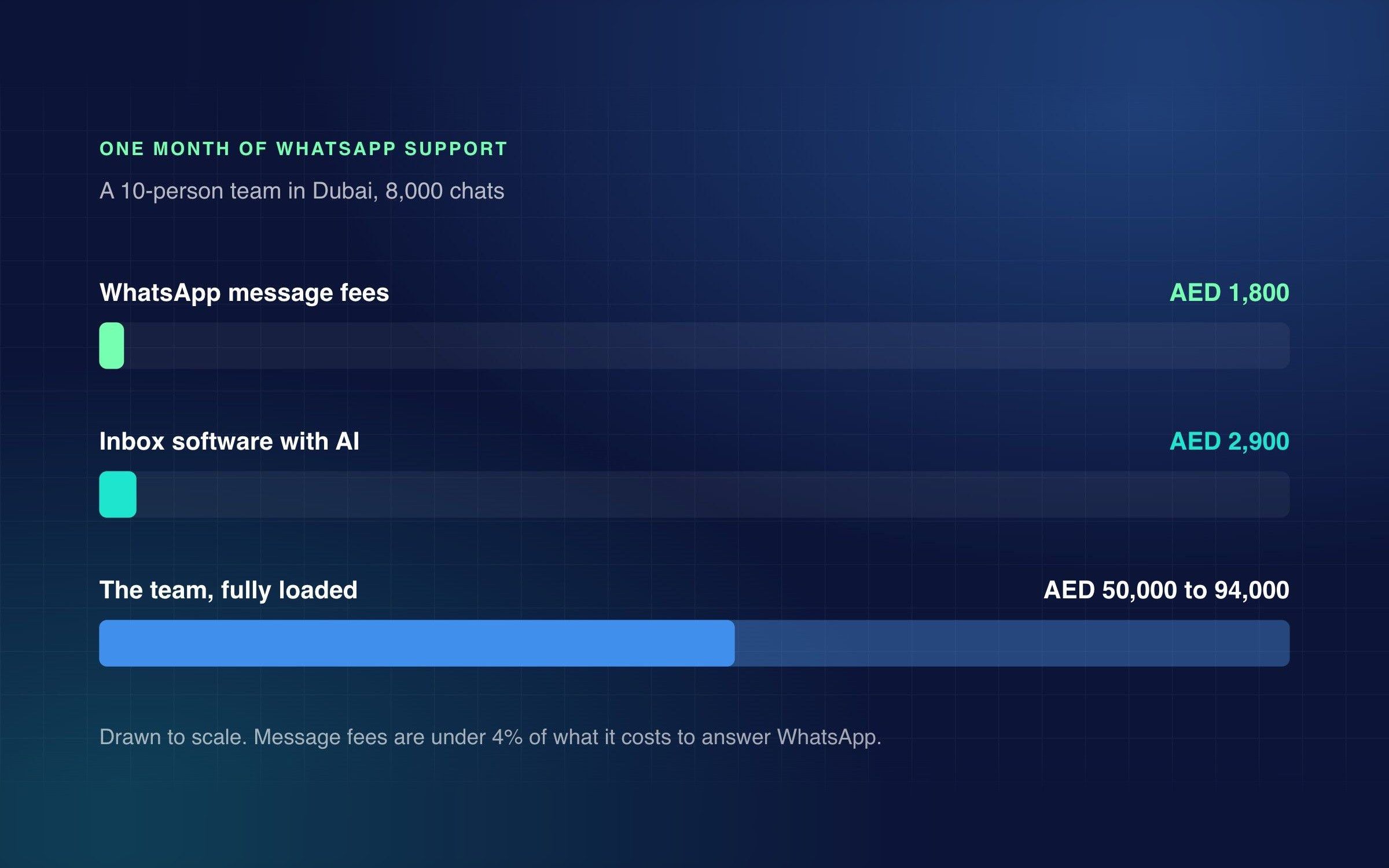

Since 1 October 2026, every WhatsApp reply to a UAE customer costs about AED 0.058 once a business number passes 1,000 replies a month. For a team handling 8,000 chats a month, that's roughly AED 1,800. The people answering those chats cost AED 50,000 to 94,000 a month once visas, insurance and gratuity are counted. The saving that matters is in their time, and AI drafting is where it comes from: one person covering the work of nearly two.
Most of the coverage of Meta's change has been about the bill. Businesses are counting messages, trimming templates and asking their providers about mark-ups. That's sensible housekeeping, and it's the wrong place to look for money.
A reply costs about six fils. The person typing it costs far more. If AI makes that person faster, the message bill barely moves and the team covers far more chats. If AI replaces that person with a bot your customers don't trust, you save on salaries and pay for it in service.
Before your next bill: four things to check this week
- There's a payment method on your WhatsApp account. Without one, Meta stops delivering replies after the free 1,000.
- How many replies you sent in October. Your provider's dashboard or WhatsApp Manager will show it.
- Whether your provider charges Meta's rates or adds a mark-up to every message.
- Whether your Meta ads send enquiries through Click to WhatsApp, which makes the next seven days of messages free.
What changed on WhatsApp pricing in October 2026?
Meta now charges for customer service replies on the WhatsApp Business Platform, after almost two years of them being free. As of October 2026, according to Meta's pricing documentation:
- Free-form replies sent within 24 hours of a customer's message are billed per message after the first 1,000 a month on each business number. It makes no difference whether a person or a third-party AI sent them.
- Utility templates (order updates, reminders) sent inside that 24-hour window are billed too. They'd been free since July 2025.
- The UAE marketing rate went up again on 1 October, its second rise in a year.
- If there's no payment method on the account, Meta stops delivering replies once the free 1,000 run out.
- Meta's own AI agent, which launched as a paid category in July, is billed separately and is charged even when other messages are free.
How much does a WhatsApp message cost in the UAE?
A reply to a UAE customer costs US$0.0157, about AED 0.058. Marketing messages cost nearly four times that. These are Meta's list rates for UAE numbers, effective 1 October 2026:
- Reply (service): US$0.0157, about AED 0.058, after 1,000 free a month per number.
- Utility template: US$0.0157, about AED 0.058, for every one, inside or outside the 24-hour window.
- Authentication (login codes): US$0.0157, about AED 0.058, for every one.
- Authentication, international: US$0.0510, about AED 0.187, for login codes from a business based outside the UAE.
- Marketing: US$0.0576, about AED 0.212, for every one.
- Meta Business Agent: about US$0.04 to US$0.05, or AED 0.15 to 0.18, for every message, even in free windows.
Messages in a Click to WhatsApp free window cost nothing, except Meta Business Agent messages. AED figures are converted at 3.6725; accounts billed in dirhams use Meta's AED rate card. Rates can change on the first day of any quarter, so check Meta's rate card before you budget.
What that means for a monthly bill, assuming four replies a chat:
- 250 chats a month (1,000 replies): free.
- 3,000 chats a month (12,000 replies): about AED 630.
- 8,000 chats a month (32,000 replies): about AED 1,790.
- 20,000 chats a month (80,000 replies): about AED 4,550.
Most small businesses will pay nothing. Everyone else pays less than they'd think.
What does WhatsApp cost a UAE business each month?
For most businesses the message bill is under 4% of what it costs to answer WhatsApp. Take a Dubai business handling 8,000 chats a month with a team of 10:
- WhatsApp message fees: about AED 1,800 a month.
- Inbox software with AI, 10 users: about AED 2,900 a month.
- The team, 10 people on base pay: AED 40,000 to 75,000 a month.
- The team, fully loaded: AED 50,000 to 94,000 a month.
Base pay comes from GulfTalent's UAE averages: about AED 4,000 a month for a customer services agent and AED 7,500 for a customer service advisor. Fully loaded adds 25% for visas, compulsory medical insurance and end-of-service gratuity, which builds up at 21 days' base pay for every year of service. RemotePass puts UAE employer costs at 20% to 35% on top of salary.
Cutting your reply count by a fifth saves about AED 360 a month. Making each person 20% faster is worth more than AED 10,000.
How do you keep the WhatsApp bill down?
The bill is small, but a few habits keep it smaller without touching service.
The biggest is the one most teams miss. A chat that starts from a Click to WhatsApp ad opens a free window of up to seven days, and replies and templates in that window cost nothing. If you already run Meta ads, point enquiries through them.
Then check what you're actually paying per message. Some providers pass on Meta's rates at cost. Others add a margin: Gallabox's published UAE rates, for example, are Meta's list rates plus 15%. A mark-up isn't wrong, but it grows with your volume, so know it's there.
And send one complete reply instead of three short ones. Each message is billed, and customers would rather get the whole answer at once anyway.
What do the AI tools cost?
You pay for three layers: Meta's channel, an inbox your team works in, and the AI that drafts or answers. For a small team, the inbox and AI together usually cost less than one salary a year. Prices below are as of October 2026.
- Inbox platform with AI (respond.io, SleekFlow, Wati): a shared WhatsApp inbox with AI drafting and simple AI agents. About US$60 to US$400 a month for a small team, plus contact or seat fees.
- AI assistant for your agents (Intercom Copilot): drafts replies inside the helpdesk. About US$29 per agent a month.
- AI agent paid per resolution (Intercom Fin): answers and closes chats alone. US$0.99 per chat it resolves.
- Meta Business Agent: Meta's own AI agent inside WhatsApp. About 4 to 5 US cents a message.
- Custom agent: drafts from your booking, CRM or policy systems in your tone. Build cost plus model usage.
Price lists don't compare well, because each tool charges for something different: a seat, a message, a resolved chat. So we put them on one measure.
What does one answered chat cost?
For our example team, a WhatsApp chat answered by a person costs AED 6 to 12. AI drafting brings that down to AED 3.50 to 7.40. A bot that closes the chat alone costs less again, but only on the chats it can close.
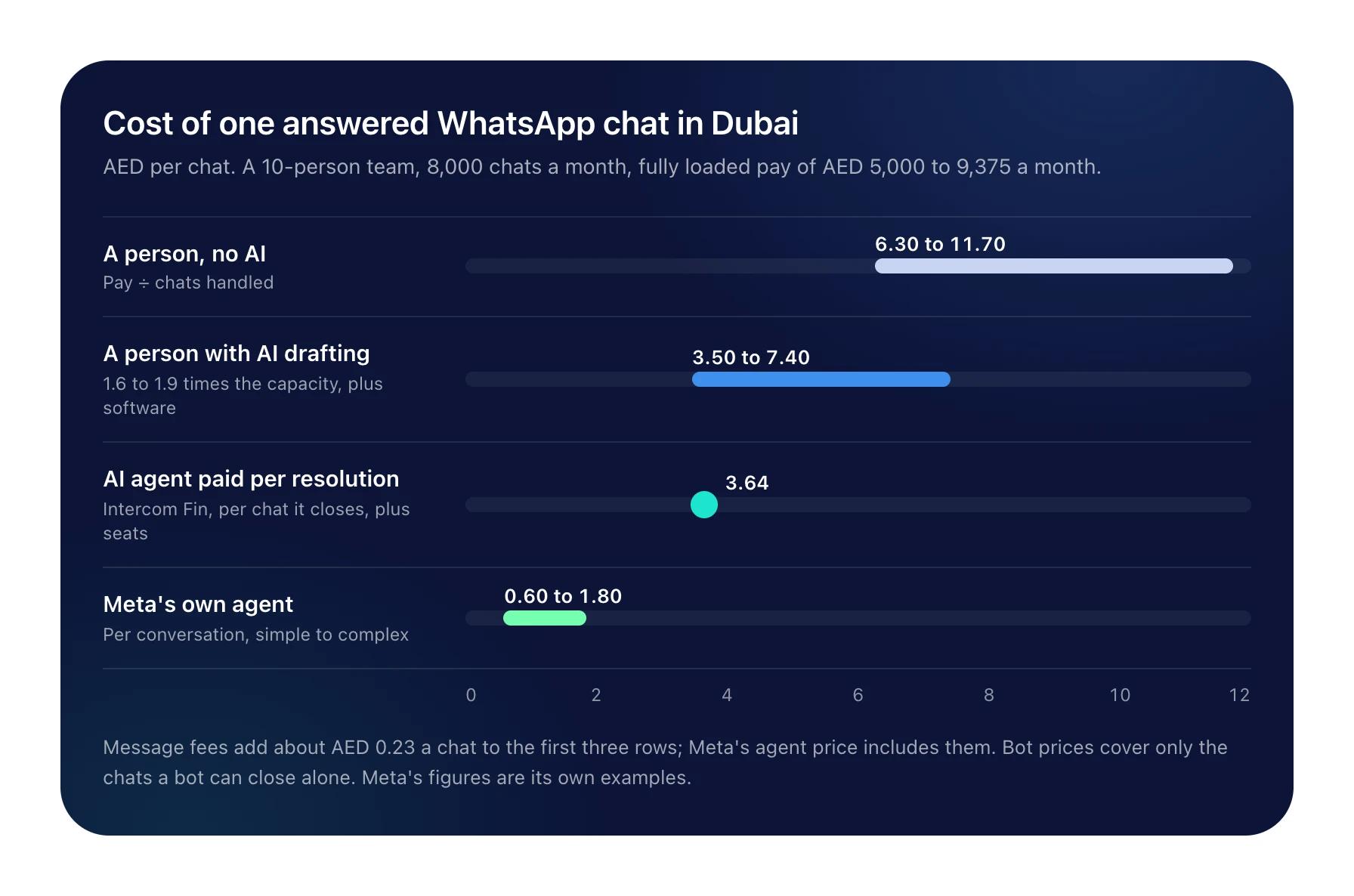
So the cheapest chat is one a bot closes on its own. That's why Tier 1 replies, like booking confirmations and opening hours, should go out without a person. The trouble is everything else. In a 2024 YouGov survey for Zbooni, 87% of UAE residents said they'd rather deal with a real person than a chatbot, and even Meta's own pricing example has its agent hand the customer to a person before the order goes through.
The cheapest setup that keeps your customers is a mix: the agent sends the routine replies, and drafts everything else for a person who can now handle nearly twice as many chats.
The example assumes each person handles 800 chats a month: 8,000 chats shared across 10 people. If your team handles more per person, every per-chat figure falls. Put your own numbers into the calculator below.
How much time does AI save a support team?
The best real-world evidence says support agents with AI drafting resolve 14% more issues an hour on average, and newer agents 34% more. It comes from Stanford and MIT researchers who tracked 5,179 customer support agents as an AI assistant was rolled out to them. The tool read each chat and suggested replies, which agents could use, edit or ignore. That's the same setup we recommend for WhatsApp.
What they found, published in the Quarterly Journal of Economics in 2025:
- Issues resolved per hour rose 14% on average and 34% for novice and lower-skilled agents. The most experienced agents barely changed.
- New agents with the tool reached in two months the level that took others six.
- Customers were friendlier to agents and asked for a manager about 25% less often.
- Fewer new agents quit.
Two things to keep in mind. The study ran in 2020 and 2021 on an AI tool that's primitive by today's standards, so treat these numbers as a floor. And its chats were 40-minute technical support sessions, so the percentages carry over to WhatsApp but the per-hour counts don't.
AI drafting helps your newest people most. That makes it as much a hiring and training tool as a productivity one.
Your best senior agent will gain little, and the study found a small dip in quality among its top performers, possibly because the suggestions distracted them.
What does that save a UAE business?
A 10-person WhatsApp team with AI drafting can cover 60% to 90% more chats, or handle today's volume with 5 or 6 people. Two things drive that: people work faster with drafts, and the agent answers the routine chats on its own. Intersect's capacity multiplier puts the two together:
Capacity per person = (1 + productivity gain) ÷ (1 − share of chats the AI answers alone)
With a 14% to 34% productivity gain and 30% of chats answered alone, each person covers 1.6 to 1.9 times what they do today. For our example team of 10 handling 8,000 chats a month:
- Same team, with AI: the 10 people cover 13,000 to 15,300 chats a month, the work of 6 to 9 extra hires.
- Same volume, with AI: 5 to 6 people handle today's 8,000 chats. That's a net saving of AED 205,000 to 527,000 a year fully loaded, or AED 157,000 to 415,000 on base pay alone.
Both savings figures subtract about AED 35,000 a year for software. Message fees are left out because they're the same either way. Set-up cost isn't included; the calculator below works out payback.
The share of chats the AI can answer alone moves the result most. Here's how much one person can cover, by that share and by how experienced your team is (experienced +14%, mixed +24%, newer +34%):
- 10% answered alone (mostly negotiation, like property sales): 1.3× experienced, 1.4× mixed, 1.5× newer.
- 30% answered alone (a typical service business): 1.6× experienced, 1.8× mixed, 1.9× newer.
- 50% answered alone (booking-heavy, like clinics or salons): 2.3× experienced, 2.5× mixed, 2.7× newer.
The industry examples are illustrations, not benchmarks. Nothing in the evidence gets you to four people's work from one.
Most businesses shouldn't cut half the team, and we wouldn't advise it. The usual win is the middle path: the same people covering evenings and weekends, taking on growth without new hires, and getting new starters useful in weeks rather than months.
Our view is that the biggest win in the UAE is bilingual staff. Arabic and English speakers are the hardest support people to hire in Dubai and among the most expensive. With AI drafting the routine English replies, they can spend their day on the chats that genuinely need Arabic.
Run your own numbers
[CALCULATOR EMBED GOES HERE: Paul to add before publishing. Remove this line once it's in.]
Where do these numbers come from?
Everything on this page is a model built from public data, not results from a client deployment. We'd rather show you the working than quote a case study we can't back up.
- Message rates come from Meta's rate card, effective 1 October 2026.
- Pay comes from GulfTalent's UAE salary data, with 25% added for employer costs, inside RemotePass's range of 20% to 35%.
- The 14% and 34% productivity gains come from the Stanford and MIT study above.
- Two inputs are our assumptions: that 30% of chats can go out without a person, and that each person handles 800 chats a month. They move the result more than anything else, so change them in the calculator to match your business.
When we have real figures from a WhatsApp deployment, we'll add them here and note it in the log at the bottom of this page.
Where the numbers fall apart
The multiplier is only as good as its inputs, and the share of chats the AI can answer alone moves it most. A business where every chat is a negotiation, like off-plan property sales or private banking, will sit near the bottom of the range above.
It also assumes three things are true. The AI drafts well in your customers' language, which for Gulf Arabic takes testing on your own chats. Your systems let the agent read the booking, order or policy it's being asked about. And someone owns the agent after launch, because drafts drift as your products and prices change.
Cutting roles has its own costs in the UAE. Every departure triggers an end-of-service gratuity payment under Federal Decree-Law 33 of 2021, and if you're subject to Emiratisation targets, check how a smaller team affects them before you restructure. Growing into the capacity is usually simpler than cutting to it.
If your team is mostly senior, expect the low end of the range. If you handle fewer than about 250 chats a month, your messages are still free and the case for anything beyond an off-the-shelf inbox is weak.
What to do next
Run your numbers in the calculator above. Then pull 200 recent chats and sort them into three piles: ones a machine could answer alone, ones it could draft for a person, and ones that need a person from the first message. That split decides what AI is worth to you, far more than any vendor demo.
See what an agent would draft for your chats
Send us 50 of your WhatsApp chats and we'll show you what an agent would draft for each, in the language your customers used, and how the three tiers would split for your business.
FAQs
How much does a WhatsApp reply cost in the UAE?
US$0.0157, about AED 0.058, per reply as of October 2026, once a business number has used its 1,000 free replies for the month. Marketing messages cost US$0.0576, about AED 0.21. Rates are set by the customer's country code and can change each quarter.
Are WhatsApp customer service replies still free?
Not since 1 October 2026. Each business number gets 1,000 free replies a month, and chats that start from a Click to WhatsApp ad are free for up to seven days. Everything else is billed per message, whether a person or an AI sends it.
Is an AI chatbot cheaper than a person on WhatsApp?
Per chat it closes, usually yes. In our example Dubai team, a person costs AED 6 to 12 a chat and a pay-per-resolution bot about AED 3.64. But bots only close the simpler chats, and most UAE customers would rather deal with a person. A mix of AI answering routine chats and drafting the rest is usually the cheapest setup that keeps customers happy.
How much faster are support teams with AI?
In the largest real-world study so far, 14% faster on average and 34% faster for newer staff, measured in issues resolved per hour. The study used 2020–21 AI tools, so current tools should do at least as well.
Related reading
- Your Customers Want WhatsApp, Not a Chatbot. Here's Where AI Fits.
- What is an AI Agent? What Business Leaders Need to Know
- 10 Time-Consuming Business Tasks That AI Can Automate Today
What's changed on this page
We update the rates and prices here every quarter, when Meta's pricing can change.
[Publish date]: First published, with Meta's UAE rates effective 1 October 2026.
Sources
- Meta: Pricing on the WhatsApp Business Platform, effective 1 October 2026
- WhatsApp API rates by country, from Meta's USD rate card, October 2026
- Gallabox: WhatsApp rate card, effective 1 October 2026
- Zbooni and YouGov survey of 1,000 UAE residents, February 2024
- Brynjolfsson, Li and Raymond, Generative AI at Work, Quarterly Journal of Economics, 2025
- GulfTalent: customer services agent salaries in the UAE, October 2026
- RemotePass: the real cost of hiring in the UAE in 2026, April 2026
- Gulf News: how gratuity is calculated under the new UAE labour law
- respond.io pricing, SleekFlow pricing, Wati pricing, Intercom pricing, checked August to October 2026