
The Hidden Cost of Manual Coordination and How Agentic AI Systems Solve the Problem
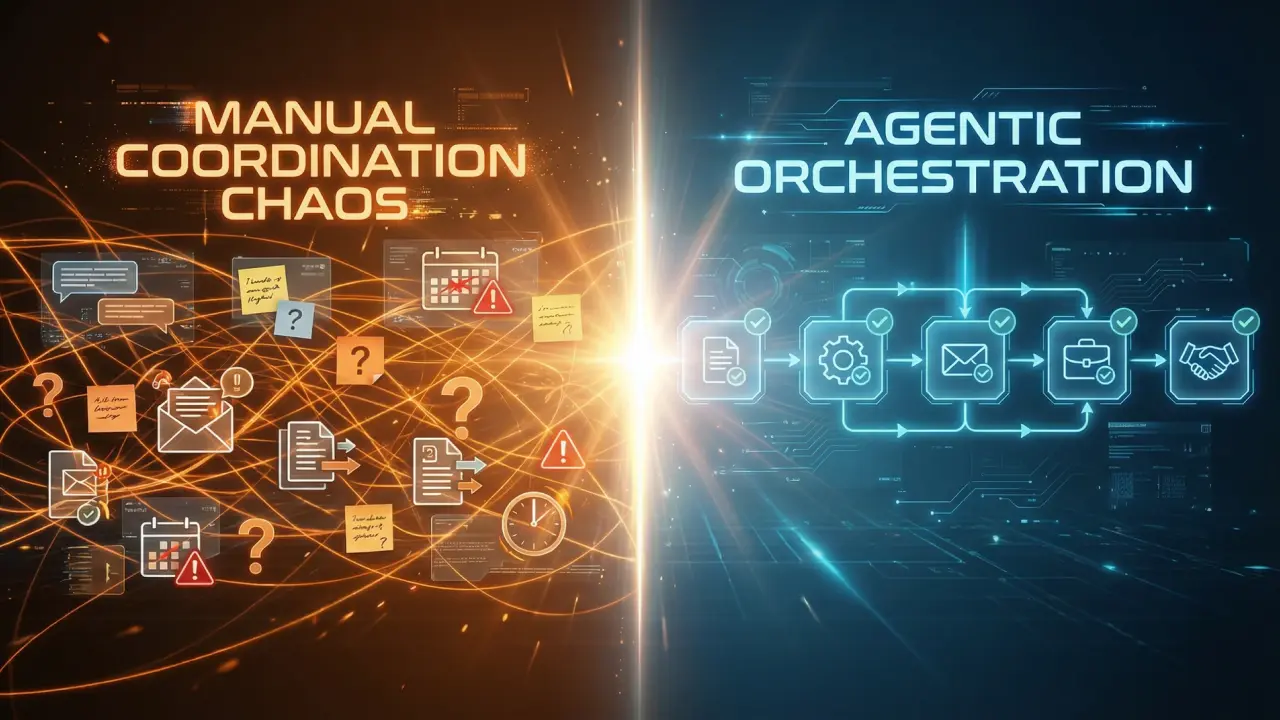
With data flying between departments and priorities shifting day by day, it’s fair to say modern enterprises are busier than ever. This kind of complexity is expected in large organisations. But with the pressure of deadlines and budget constraints, coordination often transitions to chaos, with departments prioritising their own needs without looking at the wider picture.
And this chaos is more detrimental than most businesses realise. As per Asana, employees spend 60% of their time tackling “work about work” - chasing updates, switching between tools, and handing over documents. Over a year, this leads to 103 hours of unnecessary meetings, 209 hours of duplicative work, and 352 hours just “talking about work” per employee. In other words, a large chunk of payroll is spent keeping work moving rather than doing the work itself.
Artificial intelligence (AI) has already reduced some of this burden by automating individual tasks, but one-off solutions don’t reliably keep work aligned end-to-end. Agentic AI is the next step up. These solutions plan, route, automate and orchestrate work across tools, processes, and people, while keeping humans informed for the important workflows. This can save up to 15 hours weekly per team member - time that can be spent on the tasks that are truly valuable.
In this article, we’ll explore what manual coordination looks like day to day, the real costs behind it, examine how high-performing enterprises reduce their manual coordination needs, and show how agentic AI can help enterprises operate with less friction.

What day-to-day manual coordination looks like
It’s 2026, and you’re just about to kick off your first big project of the year. You’ve spent the last few days jumping between channels to confirm who needs to be in office, where they need to be, and when. You’ve manually sifted through twenty different calendars, chased replies and stitched everything into a cohesive plan.
Then launch day arrives and two people aren’t in the office. One didn’t check and confirm their calendar invite. Another turned up on time but assumed it was online and is sitting in a Zoom waiting room. Time, energy, and resources wasted due to a misalignment of scheduling.
That misalignment is the “coordination tax” - time and momentum that you’ve lost to avoidable miscommunications and manual follow-ups. It slows delivery and turns solid plans into frustrating bottlenecks. Here’s why it happens:
- Multiple concurrent communication channels: Updates spread across Slack, Microsoft Teams, emails, and group chats mean important messages and key details get buried in casual chat or lost in an unused channel.
- Disjointed handoffs between departments: Work stalls when it moves from Sales to Legal or Legal to Finance because humans need to re-expain the context and chase confirmation each time. If any details are unclear, the request bounces back.
- Status updates vs dedicated systems: Rather than relying on a unified project management application to monitor progress, business leaders will resort to pings and status updates throughout the day, interrupting employee workflows.
- Duplicated spreadsheets: Instead of checking whether there is existing documentation for a given dataset, employees choose to start from scratch using their own fields and parameters, creating conflicting versions that lead to confusion and fractured datasets.
- Stalled decision-making: Work pauses while teams wait for approvals from busy stakeholders, leading to a loss of agility - the organisation only moves as fast as its slowest-moving respondent.
These manual coordination factors are often made worse by tools that aren’t designed to work together. Workflows become stilted, departments become isolated and coordinating across teams becomes a full time job.
The cost of manual coordination - where the money goes
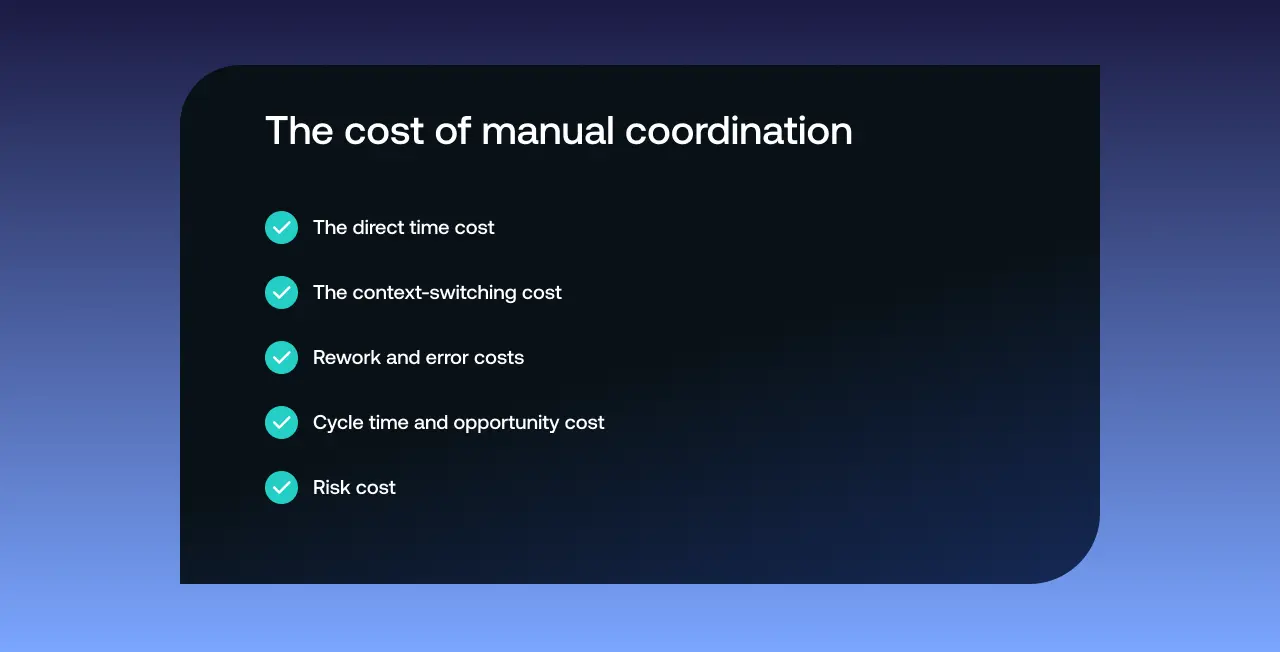
Coordination is vital in modern enterprises, but when that coordination relies on ad hoc processes rather than a clear, sustainable operating model, it leads to an operational leak that shows up across labour, finances, delivery speed, and risk. Here are some of the areas where the coordination tax reveals itself on your balance sheet and within your workforce.
The direct time cost
The area manual coordination often impacts most significantly is how an employee uses their time. Low-value coordination like status meetings, calendar wrangling and follow-ups all prevent employees from working on the tasks that matter.
For example, if a company has five $100/hour employees sitting in on a meeting to relay information to the wider workforce that could have been automated, that’s $500 immediately down the drain and time lost that could’ve been spent on high-value tasks. Many employees will also waste considerable time throughout the week chasing emails or requesting updates.
There’s also the time cost of having to explain existing concepts or updates to new stakeholders, particularly if there isn’t a single, centralised source of truth where this information can easily be accessed.
The context-switching cost
Manual coordination tends to fragment work, with people interrupted by quick questions or ad hoc requests across Slack, meetings and emails. The cost? Research from the University of California suggests it takes an average of 23 minutes to return to a state of deep work after experiencing an interruption.
If you take this figure and apply it to every employee interrupted by an unexpected phone call, or a needless request for an update via Slack, or being assigned a new task ad hoc, this time period quickly multiplies, resulting in hours of lost productivity.
Rework and error costs
We’re all prone to making mistakes, even with the highest levels of training. But these errors can often be amplified by manual coordination.
For example, an employee may spend hours producing a second version of an invitation to tender, unaware that a ‘Version 2’ already exists within a separate Slack channel thread they weren’t part of. That’s hours of wasted time and effort on the employee’s part caused by a lapse in visibility and communication.
Manual coordination also breaks down when the chain of handoffs isn’t clear. A piece of work may sit idle for hours because the next person in line isn’t aware it’s waiting for them. Business leaders may also end up making poor decisions if data is outdated and incomplete because it’s being housed across multiple sites and documents.
Cycle time and opportunity cost
Manual coordination will often create a lag between every stage or step of a project, dramatically increasing overall time-to-market. Again, this often comes down to delays in approval caused by inefficient communication channels.
This lag can also lead to a competitive disadvantage. If there’s a clear opening in your sector, with a handful of competitors all striving to create the same product or service and corner the market, the one with established agentic AI practices is more likely to succeed than the ones still relying on manual coordination.
Risk cost
Finally, there’s the cost you don’t see until something goes wrong. These hidden, unexpected costs can be particularly damaging because they’re rarely reflected in cash flows and forecasting.
The cost of accountability is one example. Businesses relying on manual, haphazard coordination often lack a clear chain of command, so they won’t know who needs to be held accountable if something goes wrong. If there are a number of competing, isolated systems and communication channels, then auditing becomes far more difficult.
Workflows where manual coordination hurts most
Enterprises are a complex mix of operations, processes and workflows that all need to work simultaneously in order for the business to succeed. Traditionally, most have relied on manual coordination to some extent.
Some business functions can absorb coordination slip-ups better than others. For example, if a marketing team is delayed in releasing promotional material, it’s rarely catastrophic for the business, particularly if the customer weren’t expecting that activity at a given time.
However, some business operations and workflows can be devastated when manual coordination breaks down. Some of these areas include:
- Employee onboarding: The first week in a new job is stressful enough. However, if certain aspects of an employee’s onboarding haven’t been completed, like payroll or access to business portals and applications, that’s a lot of time wasted in the first few days. It can also leave the employee with a negative impression of their new company.
- Procurement: Whenever a new product or service is introduced to a business infrastructure, it often requires approval from multiple departments including finance, compliance, and security. When this new procurement is critically important, delays from any one department can have a huge impact on day-to-day operations.
- Incident response and security: In the event of a security incident, response protocols need to be watertight. Poor manual coordination can severely hamper the Mean Time to Recovery (MTTR), allowing issues to escalate before teams have what they need to deal with the threat.
- Forecasting and planning: Forecasting depends on accurate data to arrive at accurate outcomes. If teams are pulling inputs from multiple sources that may be outdated or inaccurate, leaders often end up planning without a distorted picture. This leads to slow outputs and low-quality decisions.
- Customer support escalation: Dealing with frustrated customers can be a challenge at the best of times. But if a support agent doesn’t have instant access to the required solutions, or there’s no process for de-escalation, manual coordination can result in damaged customer relationships, increased customer churn, and decreased revenue.
In short, the more time-sensitive, cross-functional and high-stakes the workflow, the more expensive manual coordination will be for your employees, stakeholders and bottom line.
How high-performing enterprises reduce coordination overhead
So, why is it that some businesses have much lower coordination overheads than others?
It’s important to realise that these high-performing businesses still engage with the same processes as all businesses do. They still require business meetings, still use shared communication channels, and still rely on workflows to achieve their goals.
However, their success often starts with a shift in mindset - they focus less on managing people and more on managing the flow of information, and how it all connects together.
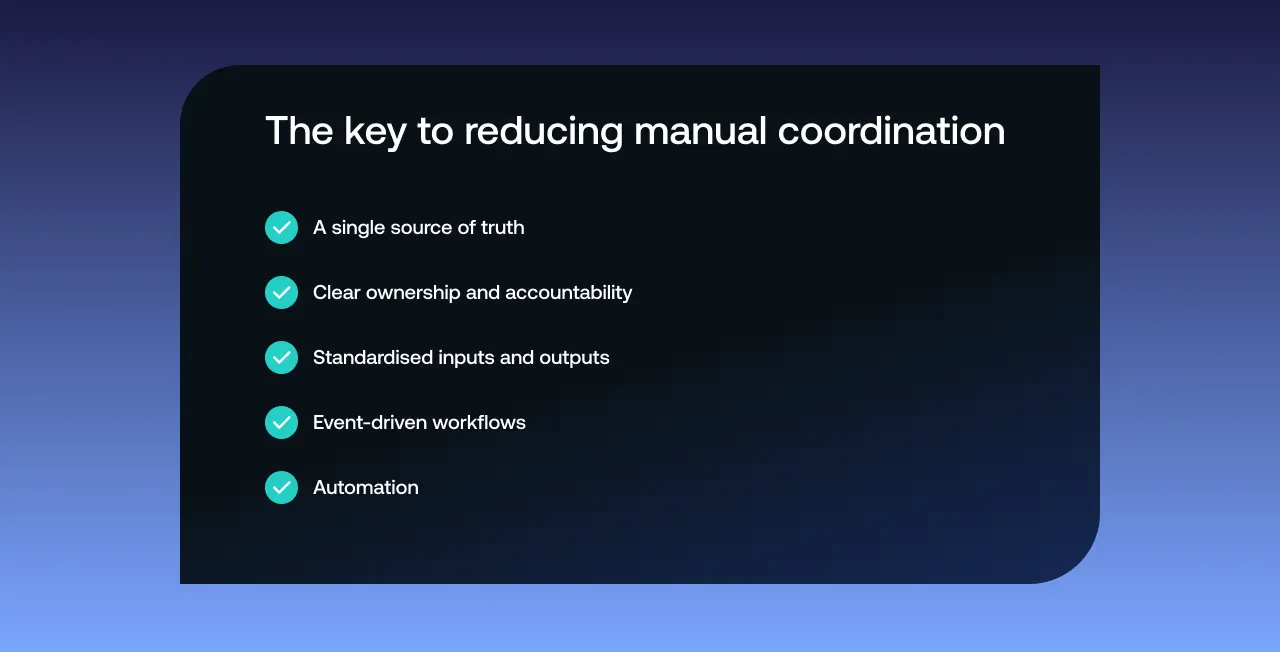
While there are no hard and fast rules for success, we’ve identified five core principles that underline how successful businesses navigate manual coordination and reduce their coordination tax.
- A single source of truth
For a high-functioning enterprise, everything begins and ends with a single source of information that integrates operations across all departments. This is often a CRM or project management tool. It becomes the agreed point that everyone accepts as gospel - if it isn’t captured in the system, it didn’t happen.
This only works when teams take ownership of data quality and have a shared responsibility to keep the CRM accurate and up-to-date at all times. All processes need to be understood, with changes clearly explained by stakeholders so every worker stays aligned.
- Clear ownership and accountability
High-performing enterprises treat accountability as a core principle, often deploying a version of RACI:
- Responsible
- Accountable
- Consulted
- Informed
This four-step theory allows the business to clearly articulate who is responsible for the work, who is accountable for the outcome (always a single person), who gives authoritative input before work is finalised (often limited), and who needs to know the outcome and how things are proceeding.
For example, if a business needs to build a new page for the website, the designer is responsible for the work but will take consultation and ideas from the marketing team to ensure branding remains consistent. Web engineers will also need to be kept informed on what’s going on. And once the work has been completed, it’s all signed off only by the Product Manager, ready for launch.
- Standardised inputs and outputs
On most occasions, much of the back-and-forth associated with poor manual coordination is caused by missing information. High-performing teams treat their workflows like an API. In order to achieve a reliable output, the same set of inputs need to be applied for each operation. This can be achieved through things such as standardised, mandatory templates and schemas that all departments within a business need to utilise.
By following the same process, and sticking to the same schemas, the ‘ping-pong’ effect of work bouncing back and forth between teams is eliminated.
- Event-driven workflows
This is often a natural consequence of the entire business working within a single CRM or project management tool. Rather than arbitrarily chasing for updates of work statuses and progress on certain tasks, high-performing businesses will use events and pipelines to inform when a piece of work is ready to be passed along.
For example, a marketing team might’ve completed their portion of a webpage, and will set the status within their project management tool to ‘Complete.’ This will automatically move the project on to the next stage of the pipeline, where it can be accessed by the content creation team to begin populating the pages.
- Automation
Eventually, a business will be able to transform practices such as standardised inputs and outputs, as well as event-based workflows, into automated processes. This will involve using tools to handle repetitive, logic-based tasks that usually require a human component.
For example, as soon as a system receives confirmation that a contract has been signed, it’ll trigger the creation of an account folder associated with the signee. There’s no checking and chasing on the part of the human agent, and no manual creation of the folder elements. Everything slowly becomes more efficient, as long as the overall process is repeated and utilised.
This automation forms the basis of what will eventually become agentic AI for the business.
How agentic AI systems reduce manual coordination
AI agents are individual AI systems designed to carry out repeatable tasks using rules and triggers - an action happens, and the agent takes the next step, leading to the desired outcome.
The beauty of AI agents is that they can be linked together - a concept known as “agentic AI”. This combines multiple agents into a multi-step workflow, turning single task automation into large-scale orchestration by replacing the inconsistent “connective tissue” of manual coordination with a structured workflow that runs across tools and teams.
Here are some of the ways that agentic AI can help to reduce the tax of manual coordination.
- Goal-oriented orchestration: Agentic AI systems work backwards from an objective and execute the steps required to reach it. This can include gathering inputs and triggering tasks, as well as routing work to the right people when needed.
- Automated handoffs: Rather than a human having to re-explain context and chase confirmation for every handoff, agentic AI can detect when a handoff condition is met, package the full context, assign the work, and track acceptance automatically, all without endless back and forth or anyone needing to manually move the workflow forward.
- Holistic conflict resolution: In customer service, agentic AI can process customer requests in context and pull relevant knowledge more specifically to propose the next best action for a human agent to approve or refine, reducing manual back and forth.
- Finance reconciliation: Instead of a human agent sifting through dozens of invoices to match records on a bank statement, agentic AI can instantly identify mismatches, search the ERP for the cause, and draft the enquiry letter to the relevant vendor.
- Improved compliance: Agentic AI can apply policy checks (approved by humans) for tasks like approvals, access, and procurement. The predefined criteria will be automatically tested against each request, and anything outside the guardrails will be routed for review.
How to get started with agentic AI
The shift from manual coordination to agentic AI doesn’t happen overnight. It’s a drastic change in working (and thinking). And it’s normal for teams to have concerns about automating tasks they’ve traditionally done themselves.
One of the most important things to establish early is that agentic AI is there to augment and support a human workforce rather than replace it. This usually involves a mindset shift, with employees working from being workflow owners to agent supervisors. Just as importantly, teams need to know what the guardrails are for human intervention and when to step in.
High-impact starter use cases
To prove value quickly and demonstrate to sceptical employees what success looks like, take a ‘quick win’ approach across workflows where coordination overhead is obvious and easy to measure. These might include:
- Security checks and escalations - log monitoring, suspicious account isolation, mediation reporting
- Customer support - moving beyond a chatbot with root cause identification for problems, knowledge base access, automated subscription renewals etc.
- Employee onboarding - seamless coordination between HR, IT, and Finance to make sure new workers have exactly what they need
- Lead qualification - AI lead scoring, personalised outreach for hot leads, client research
- IT services - triage and prioritisation of incoming tickets, autonomous software access and permissions
- Accounting - Generate and send invoices, match payments, follow up on overdue accounts, flag discrepancies and route exceptions to finance with the right context.
Track your metrics
It’s vital that you establish baseline metrics before introducing agentic AI. Without them, you’ll find it very difficult to prove your agents have had a meaningful impact and are actually reducing your coordination tax.
Some of the metrics to consider include your orchestration efficiency (the reduction in ‘wait time’ between different steps of a process), the overall number of meeting hours required, the number of handoffs per workflow, and the cost-per-task (the fully-loaded cost of a human performing a task vs. an agent).
Closing Thoughts
The ‘coordination tax’ has been draining time and budget in enterprises for years. As business operations have become more complex, many leaders fall into the trap of accepting “work for the sake of work” as normal, and the loss in time an inevitable byproduct of the modern business environment.
Agentic AI is the shift away from that mindset. Instead of humans acting as the link between systems and departments, agentic workflows handle the routing, checking and follow-ups automatically. Busy work becomes automated and integrated into a single, standardised system, with processes and workflows all combined together under the watchful eye of human agents.
That’s exactly what Intersect AI is designed to enable. We help enterprises design agentic AI systems across critical workflows to reduce manual coordination without necessitating a rip-and-replace of your existing tech stack. Our solutions are deeply integrated with the tools you already use, making it easier to orchestrate work end-to-end and stay aligned as you scale.
If your business needs to reduce coordination overhead and operate with less friction, we can help. Contact us today to talk through your first AI agent use case.
FAQs
What is ‘coordination tax’ in an enterprise context?
Coordination tax is the perceived impact that a loss or waste of time and mental energy has on a workforce (and therefore productivity). It is often a result of large enterprises with complex communication channels that eventually become misaligned. It will usually appear in the form of things such as excess meetings, unwieldy information hunting, and manual data manipulation.
How do you measure coordination overhead?
While it is more qualitative than quantitative, you can gain a good understanding of your coordination overhead by measuring things such as meeting-to-output ratio (time spent in sync meetings vs time spent in deep work), process latency (the time it takes for tasks to move along a pipeline), and context re-entry time (the time it takes for workers to return to work after interruption).
What are the differences between chatbots and AI agents?
Chatbots are often considered the precursor to AI agents. They provide simple answers to direct questions and queries that a customer may have. An AI agent takes this one step further; they are given direct goals by a business leader and will use a combination of tools and planning to autonomously fulfil these goals.
What do I need to do before implementing an AI agent?
Before setting up AI agents, you’ll need to make sure your APIs are fully accessible. You should consider a thorough data cleansing, as agents require standardised datasets in order to be fully effective. You should develop a comprehensive knowledge base and a single Source of Truth for your agent to tap into. And you should define your agent access controls across your sensitive sources.